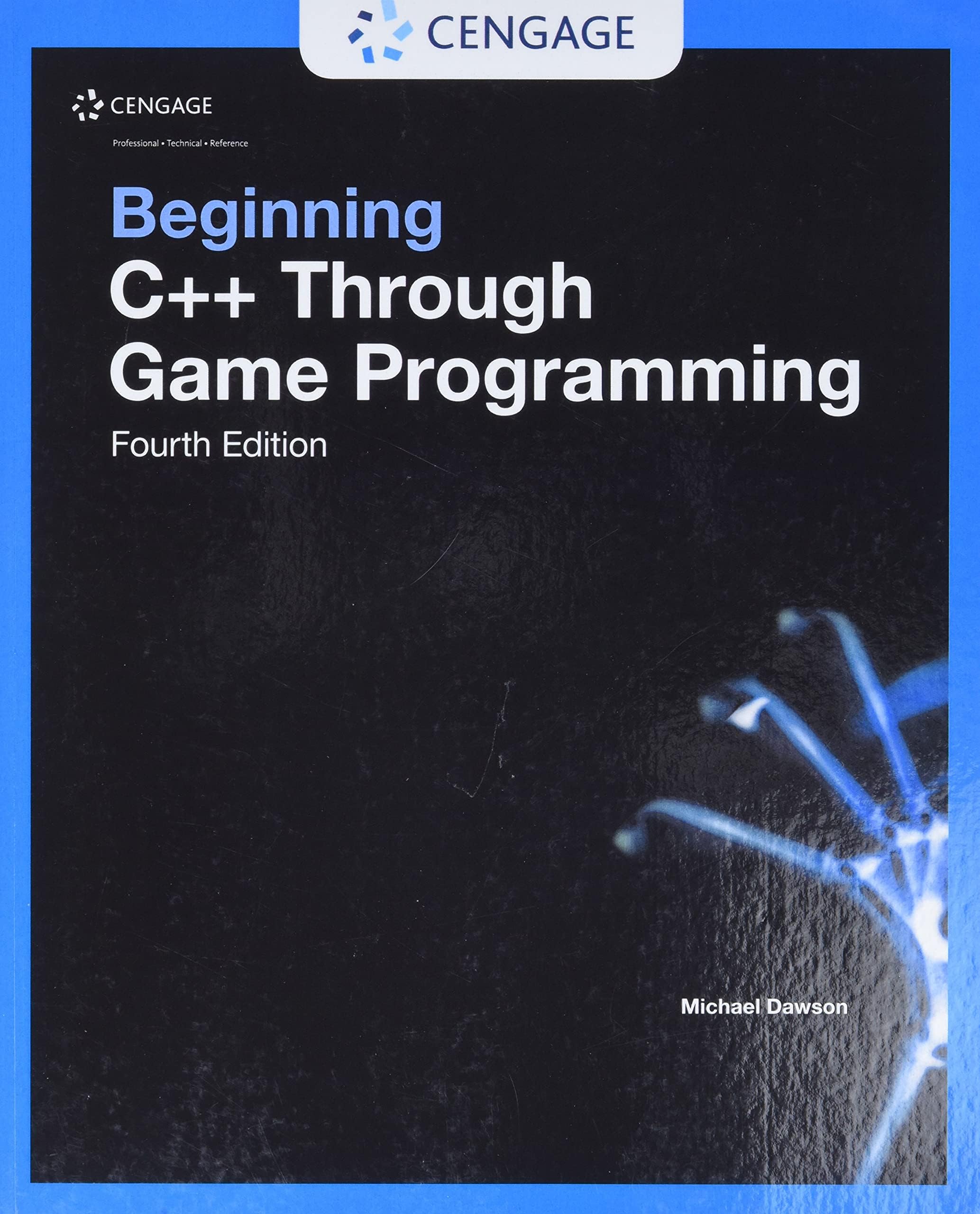
Beginning C++ Through Game Programming (Design may vary )
Product ID: 7271778
Buy anything from 5,000+ international stores. One checkout price. No surprise fees. Join 2M+ shoppers on Desertcart.
Desertcart purchases this item on your behalf and handles shipping, customs, and support to Uruguay.
When it comes to game programming, C++ is the name of the game. If you aspire to move from game player to game creator, it all starts with learning the fundamentals of C++ and game-programming basics. With BEGINNING C++ THROUGH GAME PROGRAMMING, FOURTH EDITION, you will find an up-to-date and thorough introduction to everything you need to get started�with no previous programming experience required. In the new fourth edition of this popular guide to learning C++, you will work with a complete program while learning each new concept and a game program at the end of each chapter. A final game project at the end of the book draws together everything you�ve learned. Written with the beginning programmer in mind, BEGINNING C++ THROUGH GAME PROGRAMMING, FOURTH EDITION is a great way to get started in game programming. Review: Best Introduction to C++ Available. Great as Your First Programming Book. - I’ll cut to the chase: this book is one of the best introductions I’ve seen to the C++ language. I’ve read probably at least a dozen C++ books and I would say this would be the best place to start if you’ve never used C++ or even as your first programming book. There are some great C++ resources out there, but much of the material can be too advanced for a beginner and will probably scare you off before you get anywhere. With Beginning C++ Through Game Programming, Michael Dawson builds your knowledge from the ground up. The explanations are clear and easy to understand and no previous experience is required. You don’t even have to be a gamer to get value here as most of the games explored in the text are simple things like hangman or tic-tac-toe that anyone can understand. Dawson walks you through 10 chapters, each diving into a different aspect of the C++ language, starting simply and working up to more difficult topics. The chapter breakdown includes: types and variables, branching, loops, the STL, functions, references, pointers, classes, dynamic memory, and object-oriented programming. These topics really are the most fundamental building blocks of C++, and many are applicable to programming in any language. Lots of source code is shown, and the author explains each step along the way with an impressive amount of clarity. Even though I’d consider myself an intermediate to advanced programmer, I still found some things useful in this book, particularly the usage of the const keyboard which was always somewhat confusing to me. All the examples are simple command-line programs, so you don’t need any special libraries, just an IDE that can compile C++ code, such as Visual Studio which has a free version on Windows. If you use a different operating system, you can just get whatever free IDE you want for your platform as this book uses all standard C++ code so any compiler should work. What I have found reading other books is that they may explain concepts well, and even show code, but sometimes either they don’t give enough context on how real usage would look or the examples are so complex as to be confusing for a novice. In this text, the author is clearly aiming to teach beginners and explains everything in concise terms without becoming too complex. In each chapter, there is another full example game shown, which could be typed into a computer and run. I did not actually test any of the code, as I’d rather just learn from reading, but I didn’t find any obvious errors. Each of these games are fairly straight-forward, with apps like guess my number, hangman, madlib, tic-tac-toe, etc. My one complaint is that the final chapter covers a full blackjack game, and this was much more complicated than the previous chapters and may be a bit too advanced. However, it still may be helpful to some to see what a more involved program might look like. While the title of the book is about “game programming” I wouldn’t say you need to be a gamer to gain insight here. Though having some interest or familiarly with games can help, I’d still recommend this book for anyone interested in C++ or just wanting to learn programming in general. The author manages to cover the most key aspects of the language without burdening beginners with the more arcane constructs that will likely confuse you. Keep in mind, C++ is a beast of a language, and one book will not make you a pro overnight. After reading this title, you will still likely need other resources before you are ready to build your own apps or games. With gaming in particular, you will likely also need to learn how to use libraries, various APIs, etc. and none of that is covered here. So think of this as merely a light introduction, which will build a foundation your can bring to other more complex books. That said, I really can’t imagine a better book for people wanting to get started with programming in C++. This would work as a great first coding book for teenagers or even younger. I’m not sure there is a better beginning C++ book out there, and this is highly recommended. Review: TREMENDOUS ! PROGRAMMING BOOK - Would give 6 stars if could - I waited until I completed the first 8 of 10 chapters to write this review. I have worked through and typed (fat fingered) in every script so far. This is an exceptional book in general, an exceptional computer science book, and an exceptional self learning book for computer language programming and C++ specifically. 1. Truly takes you from the beginning of C++. I am proficient in MATLAB, R, Stata, and a few other languages (historically learned Basic and Fortran in the 1980s) but C++ is my first compiled language of its type and first Object Oriented one too. BTW - C++ is amazing so far, very rich language, but lots to learn! 2. The order of the material is excellent and builds on the previous lessons/chapters. The writing is clear and error free. Most importantly, it starts with a short summary of a concept, then you write an enjoyable "game" script (think the old text based games for the most part) and run it. Then the author explains the code with additional Tips, Tricks, Traps, Hints, etc. This three step process with logical groupings shows the care of the thought put into this and likely the benefits of a fourth edition. 3. The chapters end with an excellent bulleted Summary, Q&A's, Discussion Questions, and Exercises to expand knowledge. 4. I am using Visual Studio Community 2019 as my IDE (which I highly recommend but there is a modest learning curve for VS vs. Code::Blocks IDE which is good too) and so far all the examples (quite a few) have compiled and ran without problem or error, very impressive based on my other book experiences. One note, if you set Warnings to act as Errors during compile in your settings for the compiler then I had only one issue. The use of Enumerations in one example program. I changed these the Enumeration to an Enumeration 'Class' (I am using C++17 with my VS 2019 and the Enum Class is safer and more flexible allowing you to specify types, encapsulating the name in the scope, and use type other than INT - all good things) and the warning went away. I also reset my default to allow compiling with warnings and then Enumerations provided no issue. 5. I bought both the paperback book and the kindle book. I call the kindle version (identical to the paperback) up on one of my screens and have Visual Studio on the other. I use this setup to help when I type the code into my VS cpp file and also do quick look ups on the kindle with search feature. I have the paperback open on my desk and have marked it up very extensively with two highlighters and three pen colors to reinforce ideas and concepts and draw attention to items important to me. This system has worked extremely well. I find having a marked up paper copy of the book is well worth the seemingly duplicative expense, at least for me since I learn better this way and can flip back and forth and use the index and TOC too. I still love the kindle version for all it can do to. 6. I took the time to write a detailed review because I am so impressed with the book and the detail and care the author took. I really would give it 6 starts if I could. I have five other new (C++17 ready) books on C++ and decided to use this one first after looking through them all. I am very glad I did. Thank you to the author (Michael Dawson) for this fourth edition and sharing his skill with a noobie to C++ like me, to the publisher Cengage for publishing it, and of course to desertcart for carrying it in both paperback and Kindle and making the later a prime item. This was money well spent. Wishing you all good coding!
| Customer Reviews | 4.5 out of 5 stars 536 Reviews |
C**Y
Best Introduction to C++ Available. Great as Your First Programming Book.
I’ll cut to the chase: this book is one of the best introductions I’ve seen to the C++ language. I’ve read probably at least a dozen C++ books and I would say this would be the best place to start if you’ve never used C++ or even as your first programming book. There are some great C++ resources out there, but much of the material can be too advanced for a beginner and will probably scare you off before you get anywhere. With Beginning C++ Through Game Programming, Michael Dawson builds your knowledge from the ground up. The explanations are clear and easy to understand and no previous experience is required. You don’t even have to be a gamer to get value here as most of the games explored in the text are simple things like hangman or tic-tac-toe that anyone can understand. Dawson walks you through 10 chapters, each diving into a different aspect of the C++ language, starting simply and working up to more difficult topics. The chapter breakdown includes: types and variables, branching, loops, the STL, functions, references, pointers, classes, dynamic memory, and object-oriented programming. These topics really are the most fundamental building blocks of C++, and many are applicable to programming in any language. Lots of source code is shown, and the author explains each step along the way with an impressive amount of clarity. Even though I’d consider myself an intermediate to advanced programmer, I still found some things useful in this book, particularly the usage of the const keyboard which was always somewhat confusing to me. All the examples are simple command-line programs, so you don’t need any special libraries, just an IDE that can compile C++ code, such as Visual Studio which has a free version on Windows. If you use a different operating system, you can just get whatever free IDE you want for your platform as this book uses all standard C++ code so any compiler should work. What I have found reading other books is that they may explain concepts well, and even show code, but sometimes either they don’t give enough context on how real usage would look or the examples are so complex as to be confusing for a novice. In this text, the author is clearly aiming to teach beginners and explains everything in concise terms without becoming too complex. In each chapter, there is another full example game shown, which could be typed into a computer and run. I did not actually test any of the code, as I’d rather just learn from reading, but I didn’t find any obvious errors. Each of these games are fairly straight-forward, with apps like guess my number, hangman, madlib, tic-tac-toe, etc. My one complaint is that the final chapter covers a full blackjack game, and this was much more complicated than the previous chapters and may be a bit too advanced. However, it still may be helpful to some to see what a more involved program might look like. While the title of the book is about “game programming” I wouldn’t say you need to be a gamer to gain insight here. Though having some interest or familiarly with games can help, I’d still recommend this book for anyone interested in C++ or just wanting to learn programming in general. The author manages to cover the most key aspects of the language without burdening beginners with the more arcane constructs that will likely confuse you. Keep in mind, C++ is a beast of a language, and one book will not make you a pro overnight. After reading this title, you will still likely need other resources before you are ready to build your own apps or games. With gaming in particular, you will likely also need to learn how to use libraries, various APIs, etc. and none of that is covered here. So think of this as merely a light introduction, which will build a foundation your can bring to other more complex books. That said, I really can’t imagine a better book for people wanting to get started with programming in C++. This would work as a great first coding book for teenagers or even younger. I’m not sure there is a better beginning C++ book out there, and this is highly recommended.
F**E
TREMENDOUS ! PROGRAMMING BOOK - Would give 6 stars if could
I waited until I completed the first 8 of 10 chapters to write this review. I have worked through and typed (fat fingered) in every script so far. This is an exceptional book in general, an exceptional computer science book, and an exceptional self learning book for computer language programming and C++ specifically. 1. Truly takes you from the beginning of C++. I am proficient in MATLAB, R, Stata, and a few other languages (historically learned Basic and Fortran in the 1980s) but C++ is my first compiled language of its type and first Object Oriented one too. BTW - C++ is amazing so far, very rich language, but lots to learn! 2. The order of the material is excellent and builds on the previous lessons/chapters. The writing is clear and error free. Most importantly, it starts with a short summary of a concept, then you write an enjoyable "game" script (think the old text based games for the most part) and run it. Then the author explains the code with additional Tips, Tricks, Traps, Hints, etc. This three step process with logical groupings shows the care of the thought put into this and likely the benefits of a fourth edition. 3. The chapters end with an excellent bulleted Summary, Q&A's, Discussion Questions, and Exercises to expand knowledge. 4. I am using Visual Studio Community 2019 as my IDE (which I highly recommend but there is a modest learning curve for VS vs. Code::Blocks IDE which is good too) and so far all the examples (quite a few) have compiled and ran without problem or error, very impressive based on my other book experiences. One note, if you set Warnings to act as Errors during compile in your settings for the compiler then I had only one issue. The use of Enumerations in one example program. I changed these the Enumeration to an Enumeration 'Class' (I am using C++17 with my VS 2019 and the Enum Class is safer and more flexible allowing you to specify types, encapsulating the name in the scope, and use type other than INT - all good things) and the warning went away. I also reset my default to allow compiling with warnings and then Enumerations provided no issue. 5. I bought both the paperback book and the kindle book. I call the kindle version (identical to the paperback) up on one of my screens and have Visual Studio on the other. I use this setup to help when I type the code into my VS cpp file and also do quick look ups on the kindle with search feature. I have the paperback open on my desk and have marked it up very extensively with two highlighters and three pen colors to reinforce ideas and concepts and draw attention to items important to me. This system has worked extremely well. I find having a marked up paper copy of the book is well worth the seemingly duplicative expense, at least for me since I learn better this way and can flip back and forth and use the index and TOC too. I still love the kindle version for all it can do to. 6. I took the time to write a detailed review because I am so impressed with the book and the detail and care the author took. I really would give it 6 starts if I could. I have five other new (C++17 ready) books on C++ and decided to use this one first after looking through them all. I am very glad I did. Thank you to the author (Michael Dawson) for this fourth edition and sharing his skill with a noobie to C++ like me, to the publisher Cengage for publishing it, and of course to Amazon for carrying it in both paperback and Kindle and making the later a prime item. This was money well spent. Wishing you all good coding!
A**L
Good book for beginners
This is book does a good job of introducing and explaining the basic concepts of C++ and how it can apply to game programming. However, this book only goes over the basics and doesn't explain stuff required to make an actual game like sprites, audio, game engines, saving/loading files, etc. In addition to that, the book doesn't cover Object-Oriented Programming, which is a huge if not mandatory topic needed to make games, until near the end of book. The final game project in the book is blackjack through the windows console so that should tell just how basic this book is. Nevertheless, it is still a great read if one wants to learn C++.
C**N
Buy this if you need a crash course in C++
I've been programming on and off for about 4 years now mostly in Android development. I've recently turned my eye to this book which I bought about two years ago(and never cracked open) because I want to start playing around with the Unreal Engine and Game AI. I skipped all of the basic programming concepts which I am very familiar with (whats a variable, operator precedence, for loops, etc) which is practically chapters 1-5. The second half of the book gives a beyond excellent introduction to the characteristics that distinguish C++ from all of the other languages I have experience with(C#, Java, Python, JavaScript, Swift). The examples are thorough and the author speaks in a straightforward manner. The example code is clean and concise and really drives home the point of each concept. I'm on chapter 9 / 10 right now and after reading this far I feel confident reading any programming tome/tutorials with examples in C++ and applying them for my own purposes. Definitely recommend for any beginners I read through all of the 1 star reviews and all of them were unwarranted because the reviewers bought this book expecting it to teach them how to program a game. THIS IS NOT what this book is for. This book is intended to teach you the ins and outs of the C++ language with a game programming perspective/theme.
H**D
Beginning C++ Through Game Programming, Second Edition
This book is well written and has easy instructions to guide you through each piece of code. All the code examples actually worked wich is better then some of the other books out there, As a person in his 40's and never done well at school at all and having a transport background with no programming knowledge at all I found this author to be easy to understand and his instructions were very good with a little humor thrown in just to make you feel it wasnt a chor to learn C++ This is the very basics of C++ it starts at the very beginning so if you are like me with no previous experiance in programming at all then this is a great start I had a little trouble with the system, Im using win 7 64 bit but after a little research on the net I found the solution All in All this book and the people who put this together should be congratulated A+++++++ from me
J**N
Excellent learning material
This was a great choice for me to purchase this book and I have to thank all the positive reviews on Amazon for it. Some people were apparently confused by the title on the first edition and so it was altered on the second. This book is for people who want to learn C++ as opposed to people wanting to learn game programming. This is the perfect choice for absolute beginners. The author explains things really well and assumes you know very little about programming. His writing style is concise yet light and quite methodical, starting off with basic programming structures and building his way up to classes. This book alone will not teach you everything you need to know but it surely was an excellent introduction for me into the world of C++ and the fact it used game creation as a vehicle, this made it even more interesting for me.
G**S
Best for very smart, quick learners with great amounts of creativity
I'm 30 and decided to pick up programming again after not touching it since high school. I'm interested in game development so I thought it would be smart to get something related to that. I made it through the first bit up to the section on 'classes' alright but once the 'classes' section started, I was quickly lost. I admit, this probably says something about my ineptitude. I don't know though, I just felt like there was a sudden jump in difficulty, like a lot of helpful steps were left out. Aiding this thought is that there are extremely few practice exercises included. The book goes like so: teach a concept, show brief example of how it could be used, build text-based, command-prompt game, summarize, Q&A, then provide 1-2 exercises asking you to edit code from an earlier project. This is not helpful. I recently picked up Bjorne Stroustrup's "Programming Principles and Practice Using C++" which so far, for me, has done a much better job at showing features then providing programming challenges, asking the reader to create programs to do something based on what was just learned. He also created the c++ language so I would hope his textbook would be useful... At any rate, "Beginning C++ Through Game Programming" isn't a bad book to buy but ultimately I'd recommend the more general purpose book by the guy who created the language. Unless you're creative enough to come up with your own programs to write without knowing enough to write a useful program, it's nice to have the direction offered by Stroustrup's book. Also, his book has a section on GUI programming (which I haven't reached yet) whereas this book is strictly command prompt based.
A**N
Good for beginners
As a beginner, this book is decent. You will get confused many times, but once you do the problem over and over, you start to understand it. Arrays are probably the most confusing thing so far IMO. I suggest reading a chapter 3 times back to back to fully understand. If you understand it the first time, go ahead and take the risk of reading it only once. Something you should do is at the end of your daily reading, you should write a code containing 1 of everything in the book so you remember it. I read it every day for about 1hr or 2hrs sometimes even 6. Try to quiz yourself over what goes in certain vectors. For example name the functions that are in a vector. Which would be clear(), empty(), push_back(), pop_back(), and size(). Or name the functions in a algorithm, iterator. How do you Assign a value to a returned reference. How do you display a returned Reference to a reference. How do you display a returned reference to a variable? Asking yourself questions help you learn and remember it. I suggest this book to beginners. Good luck guys!
G**)
Recomendable para empezar a programar videojuegos y su lógica
La curva de aprendizaje puede llegar a ser un poco desafiante, pero no quita que se llega a entender, el pensamiento abstracto, estructurado y ordenado , te da las bases para dar con los siguientes pasos que te dá el libro
S**L
Interesting introduction to C++
As someone who programs mostly in JavaScript and Python, I found the process of coding the simple text-based games in this book a relaxing, gentle and interesting introduction to C++. The difficulty curve of the book is constructed in such a way that you never feel overwhelmed with new features, or bored with repetition. Having said that, some of the example programs lack inspiration and I feel like an opportunity was missed here to make more interesting content. However, I'm sure a creative programmer could aim to give their own versions more of a spark. Also, the paper quality was rather disappointing and thin, leading to the distraction of seeing the other side show through slightly.
A**S
Only for absolute beginners
Not for advance programing
R**W
Michael Dawson masterpiece!
This book is excellent due to 2 words Michael Dawson The content of this book is spot on! It is for beginners or someone who wishes to refresh old skills or unused skills. He doesn't skip over parts that experienced programmers tend to do to only deal with what they feel is important. I love the methodical approach more and was able to pick up on a few great tips along the way. I looked up other books and was only able to find another priced at $549.00 I think i will wait for that price to lower a tad before picking up that book though ;) If you shop on Amazon often you will know what i mean.
W**A
Michael Dawson utiliza uma didática muito agradável
Este livro é recomendado para todos aqueles que já possuem um conhecimento prévio de alguma linguagem e querem iniciar os estudos em C++ de um jeito fácil e rápido. Michael Dawson utiliza uma didática muito agradável, bem diferente de outros livros que circulam por aí; e só por isso, ele já deveria ser adquirido. O assunto C++ não é esgotado com esse livro, mas é um bom ponto de partida para iniciantes. Obs: É preciso fazer uma ressalva que esse livro não ensina coisa alguma sobre engines gráficas; o que o autor quer dizer com o título é que ele ensina C++ através da construção de pequenos jogos.
Trustpilot
3 weeks ago
1 week ago