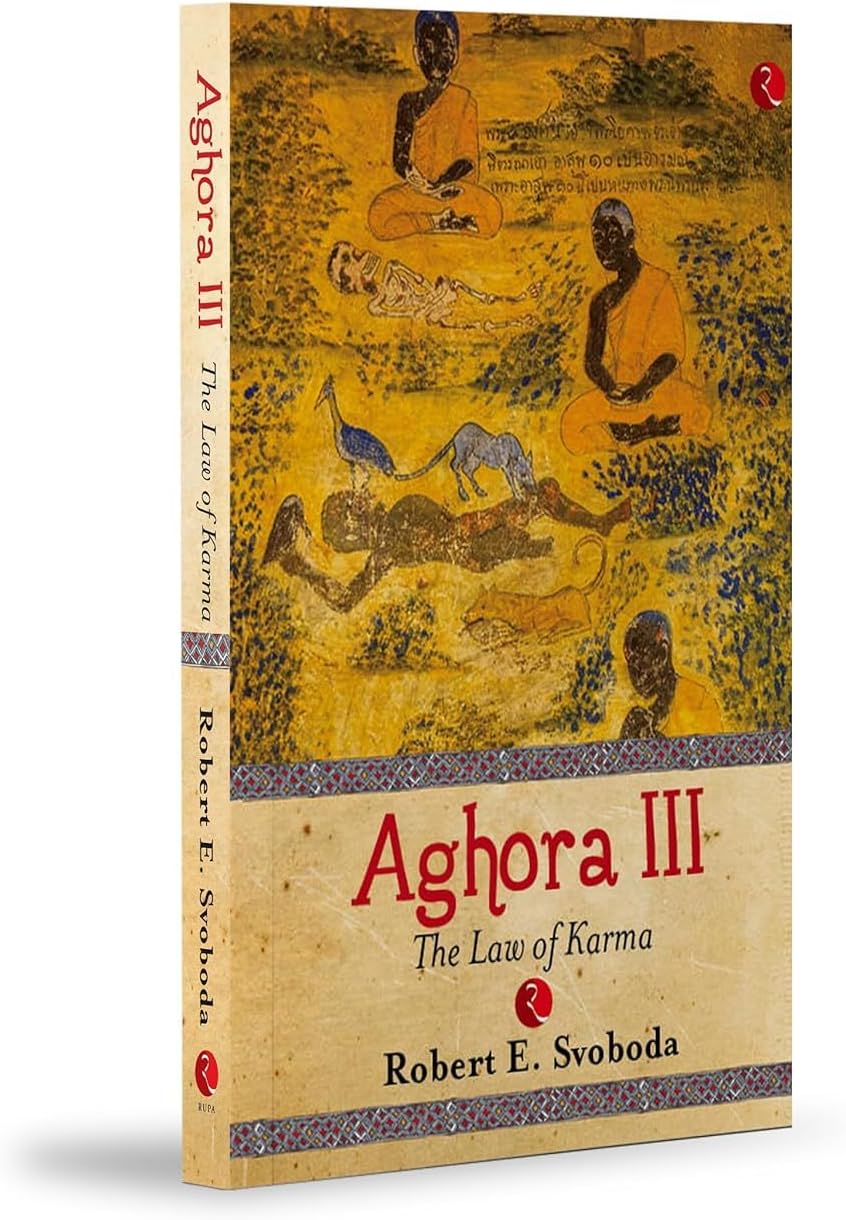
Aghora III: 3
Product ID: 79029517
🏇Metaphor of life’s race
📚Final volume of trilogy
🧠Deep spiritual & karmic insights
Desertcart purchases this item on your behalf and handles shipping, customs, and support to Uruguay.
📖 Unlock the final lap of your spiritual race—don’t miss the grand finale of Aghora III!
Aghora III: 3 is the climactic conclusion to the acclaimed Aghora trilogy by Rupa & Co, blending the high-stakes drama of the Bombay racetrack with deep explorations of karma and spirituality. This bestselling mystical tome (ranked #21 in Mysticism) weaves historical, philosophical, and metaphysical themes into a compelling narrative that challenges and enlightens readers, making it essential for those who crave profound spiritual insight wrapped in a captivating story.


| Best Sellers Rank | #7,776 in Books ( See Top 100 in Books ) #21 in Mysticism (Books) #25 in Occult & Paranormal #104 in Spirituality (Books) |
| Customer Reviews | 4.7 out of 5 stars 1,068 Reviews |
J**N
A must for 1 & 2 if alread read
Must to complete the last book. I have gone through with no much personal analysis of the narration of Dr. Robert ES, about Aghora Saint Vimalananda, in his vol1 & 2 but by the time I am about to complete 6th chapter in Vol. III, book3 of the sequel it forced me to do little of my IQ test. It started with race course and lot of narration on Horse related to race course. In-between many examples of Akbar, Birbal of whome Saint Aghora Vimalananda was a fan of as his Master's too was on Mughul Emperor. It's all fine, we can digest the good part of Mughal Emperor but by the time am concluding 6th chapter reading, titled City of Delusion here it forced me to vomit out as my digestive enzymes are not accepting the narration. Attached are pictures shot by mobile camara. Adi Shankara set an example, this point is missed in the narration. It made very strong conclusions but without considering what was state of Sanathana Dharma, Vedic life during that period. Here author compromised to say Mughul Emperor as great and intelligent, without using the words Gnani or Vignani but has concluded, Adi Shankara betrayed his mother and just as a jnani. Let's look at the episode of first spiritual Guru Lord Shiva. Shiva too has to obey the law of karma by serving 7½ years in a tree bark. Can we say Lord Shiva as agnani or limited to powers less than to Saturn. Readers, please just don't get carried away. Made very good reviews on Vol I & II, and here too am making a good point about law of karma is well explained. But, missed the target by forgetting that the Vedantic life of India is restored by only Adi Shankara. He intentionally surrendered to a chandala to bring social reform, and intentionally used parakaaya pravesha and made a compulsion that every Sanyasi should serve Al the 4 aashrama dharma. Alas, criticism is allowed in Sanatha Dharma which allows both right and left handism practices.
R**.
Amazing
Amazing Read
R**I
Very good, nic, like i buk 👍
Nic
S**I
It is a good read. go slow and imbibe the underlying
It is a good read. go slow and imbibe the underlying. It has helped me to be more objective and subjective. Get it, if in the mood for some introspection. Quality and delivery of book was good.
K**R
Excellent
Keeps one captivated
K**K
Must read
Must read
V**M
Superb book, fast delivery
Author is beyond explaination the best. Book was delivered on time and paper quality is decent. This is my third time reading this book . You can imagine how good my english is.
A**R
Too good
This total series can change ones view towards life.
E**A
Studying also the Law of Karma! Thank you Dr. Robert E. Svoboda!¡
The Aghora trilogi is the best way to learn how to be a true Aghori!!!!!! Jay Ma!!!! Jay Andjanea!!!!
S**R
Best book in the triology
In my opinion, this is the best book of the triology series. The triology is not exactly continuing series. There are gaps, between the parts. Part 3 is about The Law of Karma. Karma is simple to explain "Every action you make whether positive or negative, you will get back the benefits/ outcome of your action" with in one's life time or next birth. As per one's free will, one can find ways to escape prarabdha karma. But such actions will not get success and put one into more problems. So it is best to accept whatever comes and believe that "whatever God does is for the best". First 40 pages is the Introduction page that summarizes what has been written in next 280 pages. 280 pages consists detailed explanations, interesting points that explain well about how karma comes into play and why it is better not to avoid undergoing karma. Over all, it is a very interesting read.
A**L
It is one of views that helps to understand Vedic religion
The author is Ayurvedic consultant. The author is said to have had acquainted with his guru while the former was studying in India. we ourselves have been to India 4 times and well acquainted with Vedic religion ( what is commonly mistaking called Hinduism ), we enjoyed the author's rather poetic use of the concept of Karma. However, the word of caution here. The concept of karma is so misused by many unscrupulous gurus to exploit the mass,it is fundamental to realise, no human can define, or describe someone's karma. It is necessary to read many books on this subject to broaden the understandings of others' view, but it is dangerous and foolish to accept any view without testing it oneself. If one read this book as one of many views, good and fair, but if one takes whole of what is written in this book, then one commits error. This book is a fun to read, but not to be read as a definite text on karma.
P**R
Intriguing
I bought it for my wife and it is intriguing indeed. Highly recommended for people opting to know about spirituality. Don't forget to read the first two before hoping onto this one.
A**R
Good Intro to the laws of Karma
I read the book after having multiple Hindu friends. They would talk about Karma on occasion and I figured it would be a good topic for me to understand better! I now feel comfortable with many aspects of Karma and while it would be useless to apply Karma as quid pro quo, instant .... retribution isn't the flow of Karma rather it is a subtle force, past lives and such, it is still a power that Christianity does not explain. That is how does GOD care for us as individuals! In Hinduism we are part of a universal soul and as we indivuate that is have a sense apart from the whole, we create our own series of debt or negative karma. That Karma over 100's of lifetimes must all be unraveled and the sense of us being within a universal consciousness is our complete existence. As long as we differentiate we are separate from the universal consciousness and incomplete.
Trustpilot
2 days ago
2 weeks ago