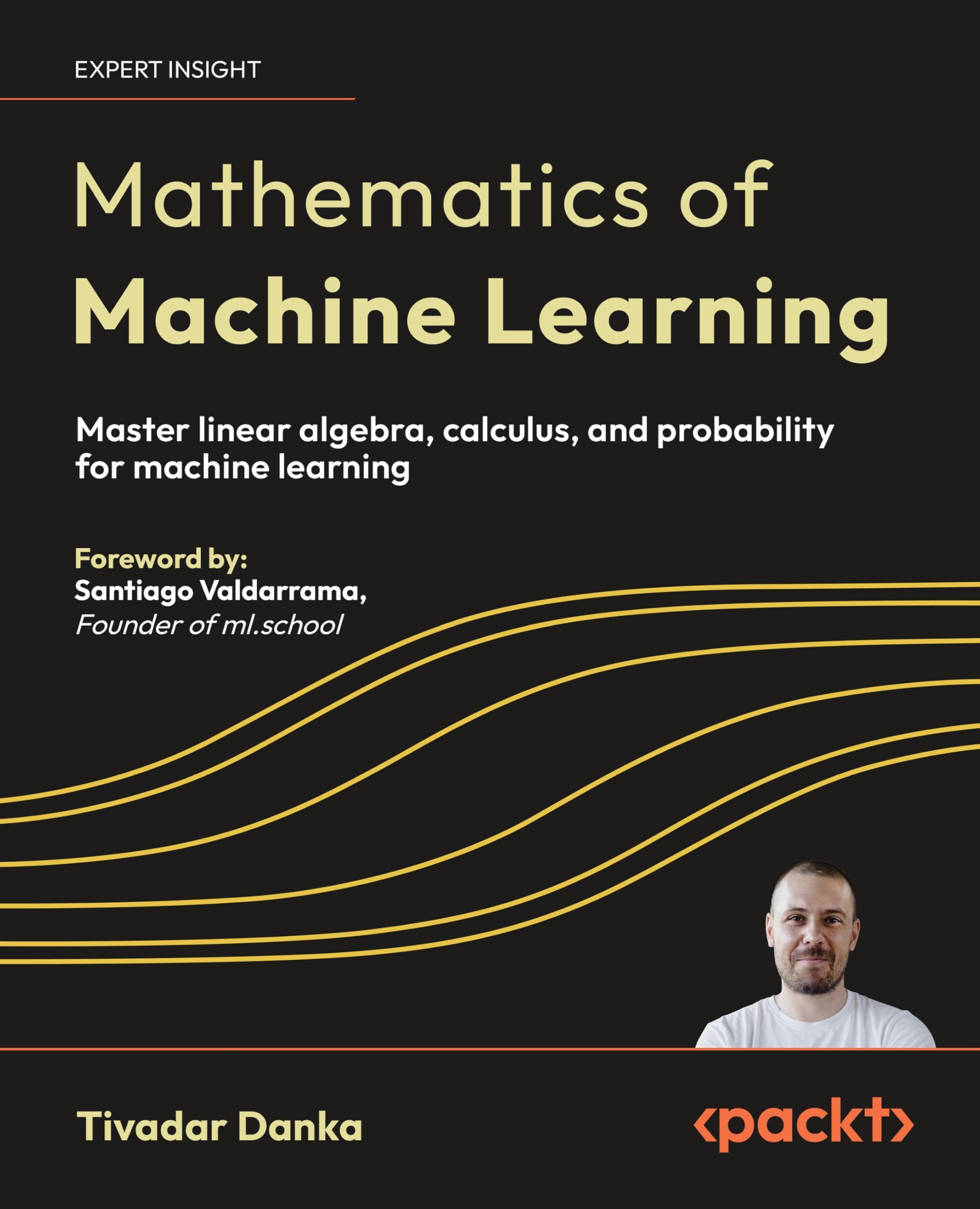
Mathematics of Machine Learning: Master linear algebra, calculus, and probability for machine learning
Product ID: 802433631
Mathematics of Machine Learning: Master linear algebra, calculus, and probability for machine learning eBook : Danka, Tivadar, Valdarrama, Santiago: desertcart.co.uk: Kindle Store Review: Too complex, at points, for its intended audience. - As others have noted in different words, the issue with this book is that it seems to assume a mathematical proficiency greater than those of its intended readers, a common failing with expert authors, who take some of their knowledge for granted. Programmers or Data Scientists who haven't done a Mathematics degree might be able to get through this book, but they will need to refer externally to make sense of the book at several (too many) points. The exercises too, IMO, are more for the maths aficionado than someone who just wants a very practical applied exposition and understanding. If, however, you have a strong undergraduate math background, you may like this book over simpler ones. Review: Tough going but a lot of great stuff in the title - Linear Algebra, Calculus and probability theory are the gates you have to walk through to understand machine learning, far more than memorising some python syntax. In the pathway to ML most courses focus on the python and fewer focus on the math. Although I might claim to know just enough of this subject to be dangerous I would not claim to be any kind of expert so I was excited to read this book. I knew I would write a lot of python yet again but I wanted to judge it on did I learn the math or did I scrape through and get by on semi-familiar syntax! The book takes little time to get into the thick of it with scikit learn and the ubiquitous Iris dataset and this is the first hurdle, within the early pages you’ll already see LaTex notation and if you haven’t done high school math you’ll be stuck quite quickly. While I was able to follow along with my level of familiarity, there are multiple points throughout the title that come with a barrier or knowkedge and understanding leap. A book like this is always going to face that challenge of course so it’s important to remember that the book is covering the math of ML, not math 101 and there is simply concepts you will have to know in order to get the best of the title. I enjoyed the title with breaks to check my knowledge outside of subject at hand so I was in very much in the stop-start mode across multiple sections of the book. The generally terse nature of the content is handled well enough, really well in places actually, but the smoothest pathway through this book would be for those pretty well versed and recently refreshed in ‘good’ high-school or college level mathematics. If you haven’t got that you will need nerves of steel and you probably will struggle with this title. All in all this one takes a bit of effort but for those covering the entry requirements it’s a comprehensive read. It’s a title that does get you to push yourself. It also shows how much work some of the python stack libraries do for you. 3.8 - 4 /5.
| Best Sellers Rank | 338,542 in Kindle Store ( See Top 100 in Kindle Store ) 16 in Mathematical Analysis (Kindle Store) 37 in Programming Algorithms 404 in Higher Mathematical Education |
D**T
Too complex, at points, for its intended audience.
As others have noted in different words, the issue with this book is that it seems to assume a mathematical proficiency greater than those of its intended readers, a common failing with expert authors, who take some of their knowledge for granted. Programmers or Data Scientists who haven't done a Mathematics degree might be able to get through this book, but they will need to refer externally to make sense of the book at several (too many) points. The exercises too, IMO, are more for the maths aficionado than someone who just wants a very practical applied exposition and understanding. If, however, you have a strong undergraduate math background, you may like this book over simpler ones.
E**D
Tough going but a lot of great stuff in the title
Linear Algebra, Calculus and probability theory are the gates you have to walk through to understand machine learning, far more than memorising some python syntax. In the pathway to ML most courses focus on the python and fewer focus on the math. Although I might claim to know just enough of this subject to be dangerous I would not claim to be any kind of expert so I was excited to read this book. I knew I would write a lot of python yet again but I wanted to judge it on did I learn the math or did I scrape through and get by on semi-familiar syntax! The book takes little time to get into the thick of it with scikit learn and the ubiquitous Iris dataset and this is the first hurdle, within the early pages you’ll already see LaTex notation and if you haven’t done high school math you’ll be stuck quite quickly. While I was able to follow along with my level of familiarity, there are multiple points throughout the title that come with a barrier or knowkedge and understanding leap. A book like this is always going to face that challenge of course so it’s important to remember that the book is covering the math of ML, not math 101 and there is simply concepts you will have to know in order to get the best of the title. I enjoyed the title with breaks to check my knowledge outside of subject at hand so I was in very much in the stop-start mode across multiple sections of the book. The generally terse nature of the content is handled well enough, really well in places actually, but the smoothest pathway through this book would be for those pretty well versed and recently refreshed in ‘good’ high-school or college level mathematics. If you haven’t got that you will need nerves of steel and you probably will struggle with this title. All in all this one takes a bit of effort but for those covering the entry requirements it’s a comprehensive read. It’s a title that does get you to push yourself. It also shows how much work some of the python stack libraries do for you. 3.8 - 4 /5.
Trustpilot
2 months ago
1 month ago