
DOWNLOAD THE APP


Customer Services
Copyright © 2025 Desertcart Holdings Limited
DOWNLOAD THE APP


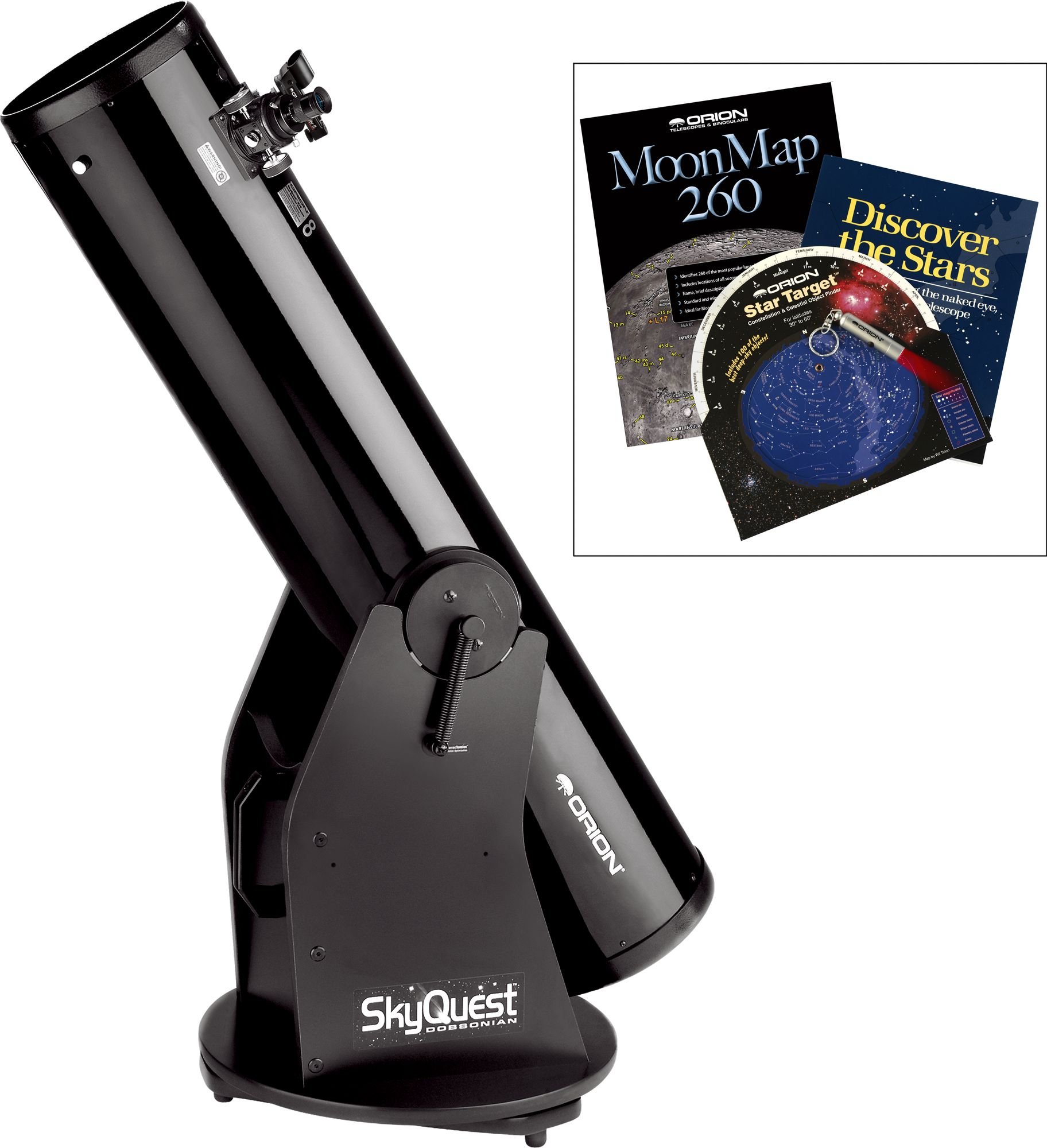

🌌 Own the night sky—because the universe waits for no one!
The Orion 27194 XT8 Classic Dobsonian Telescope features a powerful 8-inch (203mm) aperture and 1200mm focal length, delivering stunning views of the Moon, planets, and deep space objects. Its user-friendly Robesonian mount ensures smooth, precise navigation, while the included 2x Barlow lens doubles magnification options. Designed for beginners and enthusiasts alike, it comes with a comprehensive stargazing toolkit and durable construction, making it an exceptional value for anyone ready to explore the cosmos.
| ASIN | B003ZDEUS2 |
| Customer Reviews | 4.2 4.2 out of 5 stars (53) |
| Date First Available | November 1, 2003 |
| Item Weight | 41 pounds |
| Item model number | 27194 |
| Manufacturer | BINGBING |
| Package Dimensions | 50.5 x 22.5 x 22.5 inches |
A**E
Great Starter-Intermediate Telescope
The Orion XT8 is a fantastic telescope. Instructions are very easy to follow and Telescope is simple to put together. Give yourself a good 30 minutes to put it together. It is on the heavier side if youre use to smaller aperature Telescopes but well worth it. The views are spectacular. The only thing that is slightly difficult to get use to is perhaps the single handle for traveling. The main part moves slightly and can seem wobbly at first, give yourself time to properly adjust to moving the Telescope before actually transferring it outside. The EZ II finder works fantastic, may need a slight adjustment, but is a very simple fix. I recommend using a polarizing moon filter for great detailed views of the moon. Great Telescope and great company. Orions customer service was very helpful when I needed tracking information.
M**.
Probably more than we need, but also exactly what we needed
I have a problem--I need to buy the biggest and best, and I usually go overboard. I know this, my wife knows this, and my 4-year-old daughter knows this. My purchase of this telescope is a story of me going overboard. Over the last six months, my daughter has been showing an increasing interest in astronomy. When she asked for a telescope for Christmas - I jumped at the chance to get her one. Mostly because I, too, want a telescope. Taking these needs into mind, I wanted to find a telescope that would be easy to use, grow with my daughter's interests, and serve as platform to support our shared hobby. Ultimately, I chose this telescope. I assembled it on Christmas eve while my wife watched on in amused horror. This is a big telescope. "I thought it would fit on a table," she said. It's big enough that it now has a dedicated storage spot in our living room. In fact, it's too big. I lug it outside 2-3 times a week, when the sky is clear, but moving it around isn't easy. It's tall, it's awkward to carry, and if you're as uncoordinated as me, it slips and slides every-which-way when you're moving it around. But, it is easy to use. Once I get it outside, I can quickly find objects of astronomical interest and get a great view ready for my wife and daughter. And it will grow with my daughter, allowing her to take this hobby pretty far before the limits of the telescope--such as the low-quality primary mirror, which introduces a level of fuzz to distant viewing--will start holding her back. Finally, this telescope has done something that none of it's specifications would suggest--it's given my daughter and I something to get excited about. The moon was full on Christmas night and, by luck, our Washington skies were clear. We drug the telescope outside and pointed it up there and, for the first time ever, my daughter could see the moon as something other than a bright light in the sky. It hung like a rock in the viewfinder, all its pits and craters highlighted as though looking at a stone through a magnifying glass, its light blinding and delivering a new-found understanding of worlds beyond this. While it's bigger than we probably needed, and it's awkward to lug around, this telescope has delivered exactly what I needed and more. With the lenses and materials in this kit, you'll be able to view the moon beautifully with just the 25mm lens. I can also clearly see the Orion nebula from my backyard, which is near a big city. Even with the barlow, planets aren't magnified enough for optimum viewing, but if you purchase a 6mm lens as well, you'll be in great shape. Terrestrial viewing is also great. I'd recommend grabbing one of the sky viewing apps to orient the night's sky while you get used to star charts.
D**M
(: Saturn :)
Excellent value, prompt shipping, nicely packaged, and easy to assemble. Just a few comments: 1) If your a beginner like me, its probably better to buy to book Nightwatch first, before buying your telescope. The book contains an excellent chapter on choosing the right telescope and eyepieces for your use and night conditions. For example, "Dob" mounted reflectors are not the best choice for photography. 2) With all the beautiful and colorful pictures of the stars, it is easy to develop some unrealistic expectations on what you will actually see with your telescope. Our eyes don't see colors well in low light condition, so don't expect brilliant colors. Most objects will look the color of the moon. Stars will still appear as points of light. 3) There have been some negative comments on the factory finder scope, which I don't agree with. What I found was it was somewhat difficult to get the finder scope firmly attached to the telescope. The first time I attached the finder scope, it was noticeable loose. It took a couple of tries to get it firmly attached. Another possible problem is the instruction's advice to align the finder scope with the telescope on an object at least 1/4 mile away. The further away, the better the result. At least 2 miles would be my recommendation. I found the finder scope, securely attached, and properly aligned to be a very good product. There will likely be a learning curve for people without experience in looking through eyepieces. I was a surveyor for a few years, so that helped. 4) The size of the unit, and the stiffness of the movement could be a problem for a young astronomer or someone with physical limits. The telescope does break away from the mount very easily, so that is a big plus for moving the scope around. 5) Here is an old surveyor tip for working with an inverted image. Pretend like your pushing the object to the middle of the screen, rather than pointing the scope at the object. This will make you move in the opposite direction. Us directionally challenged people need all the help we can get. A quick update after owning the scope for a few months: I had started seeing a fuzzier image, so I rechecked the collimation for the second time. I had checked the collimation right after receiving and it was spot on. When I checked the collimation the second time, the telescope was out of adjustment. Some of the adjustment screws in the secondary mirror were completely loose. Only one of the set screws in the primary mirror was tightened. I had been using the scope in different locations, and maybe moving the scope around had loosened things. It is also possible that the screws were not tightened to begin with. Be sure to check all the screws, primary set screws and secondary adjustment screws, to be sure they are not loose. Orion has a very good on line instructions for collimation.
Trustpilot
1 week ago
3 weeks ago