We remain fully operational. Our teams are working around the clock to ensure your deliveries continue safely.

DOWNLOAD THE APP


Customer Services
Copyright © 2025 Desertcart Holdings Limited
DOWNLOAD THE APP
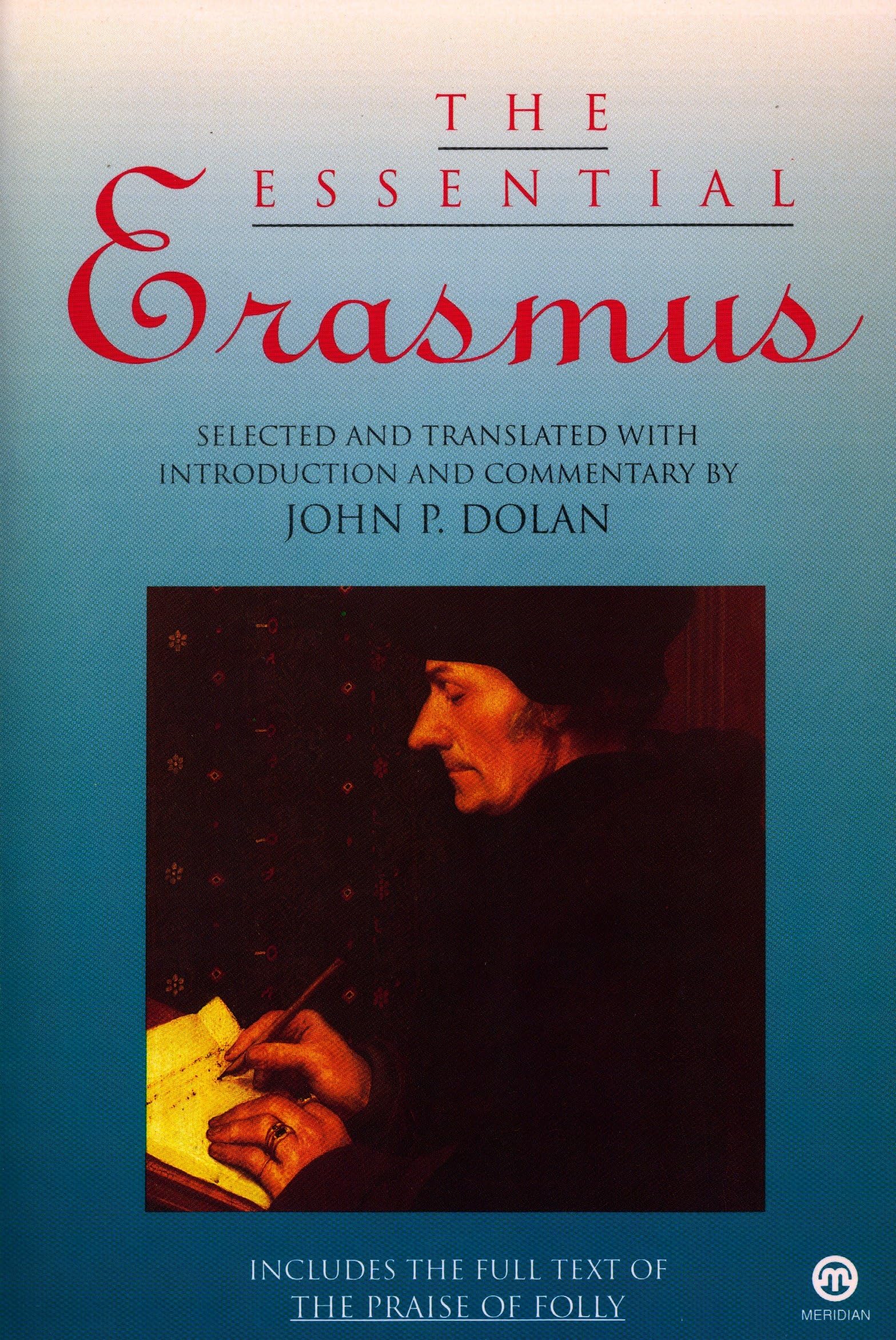
The Essential Erasmus: Includes the Full Text of The Praise of Folly [Erasmus, Desiderius, Dolan, John P.] on desertcart.com. *FREE* shipping on qualifying offers. The Essential Erasmus: Includes the Full Text of The Praise of Folly Review: A Formidable Liberality We So Desperately Need - Handbook for the Militant Christian. Sounds offputting doesn't it? A call to arms to defeat some faceless infidel, a war cry to wage against the world? In a word, no. In the last chapter, Erasmus makes no bones that we are to forgive those who harm us and love those who would do us ill. We should look to the Supreme Example, Christ, who died for a world that didn't accept Him, and in so doing gained the keys to the Kingdom. Revenge only deepens hurt and portends disaster, Erasmus lets us know on a more practical level. In seeking recompense for errors committed against us, we ironically only create more trouble for ourselves and not our 'enemy'. In these words, I have not found a better voice that blends the best Pagan Wisdom with the Truth of the Revealed Word. So who is the enemy? Earlier in the book, Erasmus lets us know it is the flesh. We have both an inner and outer man. The outer, connected to the world and all it's trappings, the possibilities of gluttony, drunkenness and lustful pursuits which only end in death, and that inner man, which is connected to things Spiritual, and Christ utmost. Clearly, as St. Paul stated, who is oft quoted here by the author, the flesh must be crucified. We must recognize another irony. That the more we deny the flesh, the more we flourish Spiritually. Thoughts are given on how to flee temptation, where we are urged to reign in Vanity, Pride in order to live a simple, humble, Christian life. Seneca wrote letters to a Stoic. Erasmus wrote this manual for a boy just being initiated into manhood. What a resplendent re-capitulation of the Old World Wisdom during the Renaissance where the knowledges of Plato, Origen and Augustine could once again be remembered and carried forward to us here in the postmodern world. A gem. Review: Good Erasmus compilation for the lay reader - I really like Erasmus, and after studying him in a reformation class I decided to look for a collection of his writings, and this is a nice, cheap copy. Erasmus is a difficult person to analyze and figure out what exactly he is after. His writings can be confusing at times and one may sometimes wonder the applicability of some of his words for today; of course, such was very significant in the time period in which they were composed. Though their bearing may not have as much salient application to todays world, I think it is still very relevant, especially when considered with the proper perspective; if the writings themselves are not directly relevant, surely the motivation for his writings are. One would be wise to analyze their self, the modern church, and the modern world in light of his ideas and consider what he would propose did he live today.
| Best Sellers Rank | #560,550 in Books ( See Top 100 in Books ) #141 in Medieval Western Philosophy #197 in Renaissance Literary Criticism (Books) #340 in Humanist Philosophy |
| Customer Reviews | 4.2 4.2 out of 5 stars (27) |
| Dimensions | 5.31 x 0.91 x 8 inches |
| Edition | Reissue |
| ISBN-10 | 0452009723 |
| ISBN-13 | 978-0452009721 |
| Item Weight | 11.8 ounces |
| Language | English |
| Print length | 400 pages |
| Publication date | May 1, 1964 |
| Publisher | Penguin Publishing Group |
K**R
A Formidable Liberality We So Desperately Need
Handbook for the Militant Christian. Sounds offputting doesn't it? A call to arms to defeat some faceless infidel, a war cry to wage against the world? In a word, no. In the last chapter, Erasmus makes no bones that we are to forgive those who harm us and love those who would do us ill. We should look to the Supreme Example, Christ, who died for a world that didn't accept Him, and in so doing gained the keys to the Kingdom. Revenge only deepens hurt and portends disaster, Erasmus lets us know on a more practical level. In seeking recompense for errors committed against us, we ironically only create more trouble for ourselves and not our 'enemy'. In these words, I have not found a better voice that blends the best Pagan Wisdom with the Truth of the Revealed Word. So who is the enemy? Earlier in the book, Erasmus lets us know it is the flesh. We have both an inner and outer man. The outer, connected to the world and all it's trappings, the possibilities of gluttony, drunkenness and lustful pursuits which only end in death, and that inner man, which is connected to things Spiritual, and Christ utmost. Clearly, as St. Paul stated, who is oft quoted here by the author, the flesh must be crucified. We must recognize another irony. That the more we deny the flesh, the more we flourish Spiritually. Thoughts are given on how to flee temptation, where we are urged to reign in Vanity, Pride in order to live a simple, humble, Christian life. Seneca wrote letters to a Stoic. Erasmus wrote this manual for a boy just being initiated into manhood. What a resplendent re-capitulation of the Old World Wisdom during the Renaissance where the knowledges of Plato, Origen and Augustine could once again be remembered and carried forward to us here in the postmodern world. A gem.
M**E
Good Erasmus compilation for the lay reader
I really like Erasmus, and after studying him in a reformation class I decided to look for a collection of his writings, and this is a nice, cheap copy. Erasmus is a difficult person to analyze and figure out what exactly he is after. His writings can be confusing at times and one may sometimes wonder the applicability of some of his words for today; of course, such was very significant in the time period in which they were composed. Though their bearing may not have as much salient application to todays world, I think it is still very relevant, especially when considered with the proper perspective; if the writings themselves are not directly relevant, surely the motivation for his writings are. One would be wise to analyze their self, the modern church, and the modern world in light of his ideas and consider what he would propose did he live today.
N**N
Five Stars
Arrived on time and as expected.
A**S
The Spirit of Vatican II
The most remarkable feeling a new reader of Erasmus has is that he speaks in the spirit and language of Vatican II. His spirituality is based on gentle reminders of all humankind’s dependence on God’s mercy, an emphasis on right living as compared to dependence on ritual and a focus on the centrality of Jesus to the Christian religion. Seeking to bridge the growing rift between Luther and Catholicism, Erasmus offered an alternative that took the criticisms of Luther seriously while still adhering to an orthodox Catholic faith. That the council of Trent largely repudiated this approach is something that cast a shadow on Europe for hundreds of years. It’s interesting that he was a close friend of the Catholic martyr Thomas More. Erasmus and More shared a common vision that Europe, in the sixteenth century, simply could not realize held the promise of peace. Well-written, pertinent to modern concerns and a genuine joy to read I strongly recommend the reading of Erasmus to those interested in modern European history. One can scarcely reimagine modern history if Erasmus had been listened to. Undoubtedly a happier era would have dawned.
P**N
Very small font. Does not include his Freedom of the Will.
Very small font. Does not include his Freedom of the Will.
C**E
Class requirement.
Bought for a class, so it wasn't particularly enjoyable.
H**A
One of the boldest books ever written!
Traveling toward England, Erasmus conceived the idea a little book that would become a referential text for the readers of the future. Dedicated to Thomas Moro making a curious twist of words between the name Moro and the Greek term "Moria" that designs the madness. This was a game in which he has thinking, but eventually will turn in a dangerous game. The text is apparently written by the madness itself and it says that it is the most powerful force which impulses the human life, and that all what it happens between men would be sadder, more mournful if not by its presence. This sort of allegation of the madness has a dark and corrosive emendatory, that precisely is what explicitly Erasmus is affirming. "All of you, men that populates Europe, loaded of destiny, are somehow madmen, foolish, people who ignore what you do or even go, and worst still, even don? t know the weight of your responsibilities." But wisely, he does not say in the serious tune of a preacher man, but in a mockery tune of this light satire that allows that such important isues be said and eventually contribute to shock the European conscious in a moment that was mature for that shaking, without great risk for the man who said it. It is absolutely fundamental for any illustrated person its reading. This is one the most transcendental texts of the Western civilization, In this sense this is a smart essay that will help us to understand evenc ?poser yjis egregious mind.
L**R
disappointed
i bought the book thinking it was more on thoughts but it turns out it was on religon which i did not find real seller was good i made a mistake
R**E
I love this book.
Trustpilot
4 days ago
2 weeks ago