Some deliveries may take a little longer than usual due to regional shipping conditions.

DOWNLOAD THE APP


Customer Services
Copyright © 2025 Desertcart Holdings Limited
DOWNLOAD THE APP
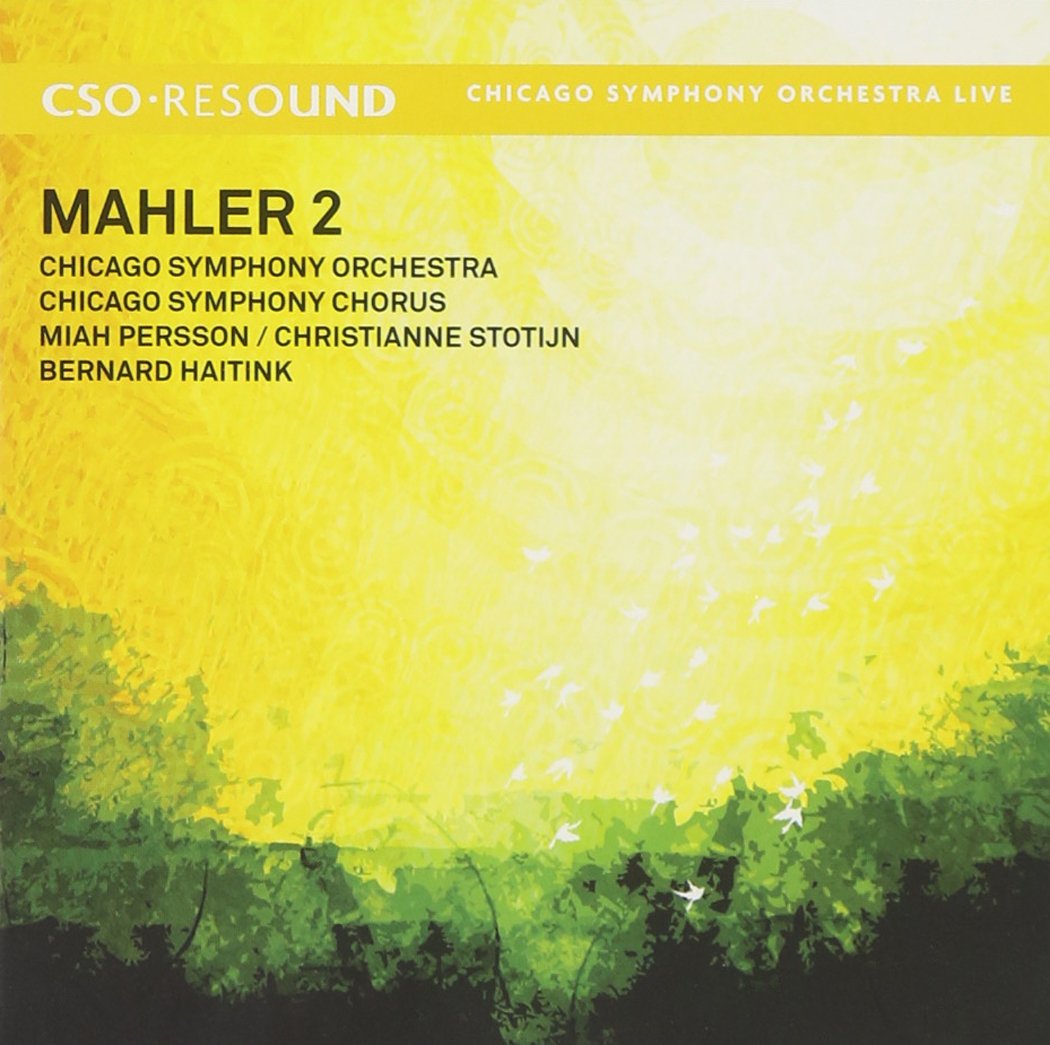
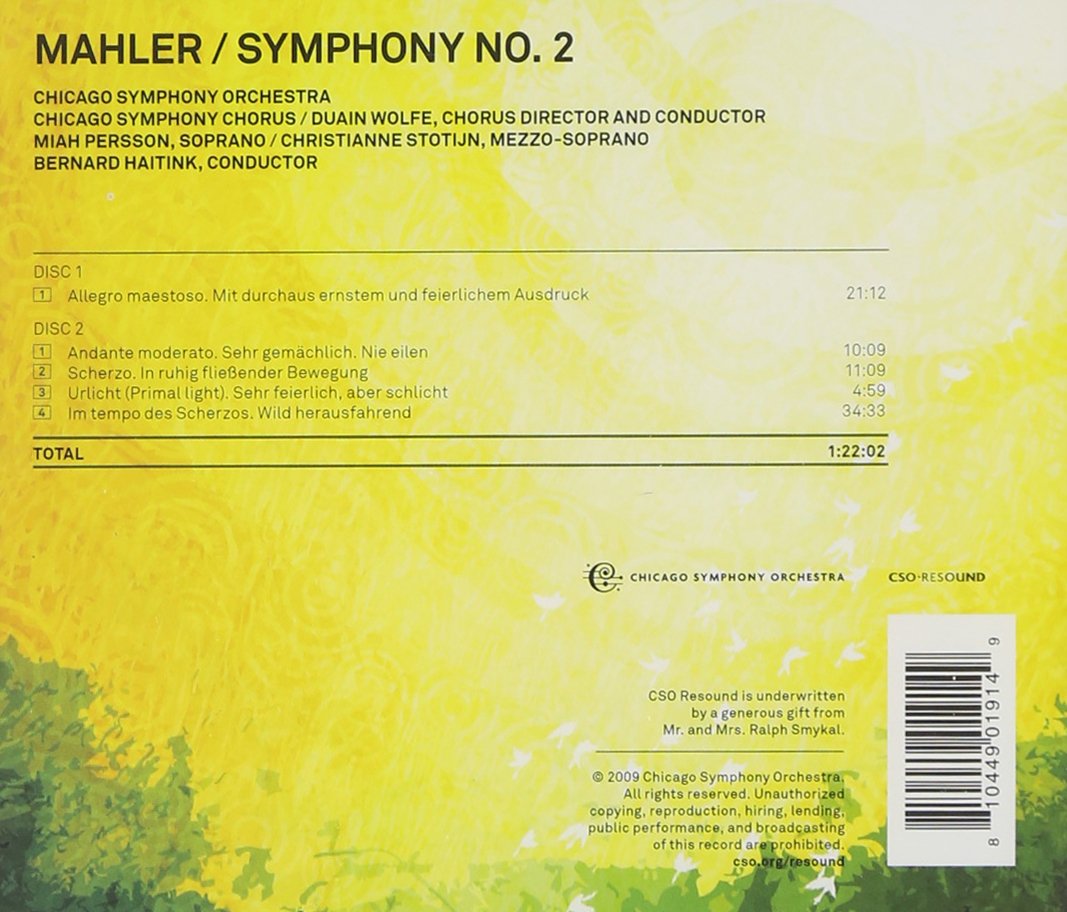
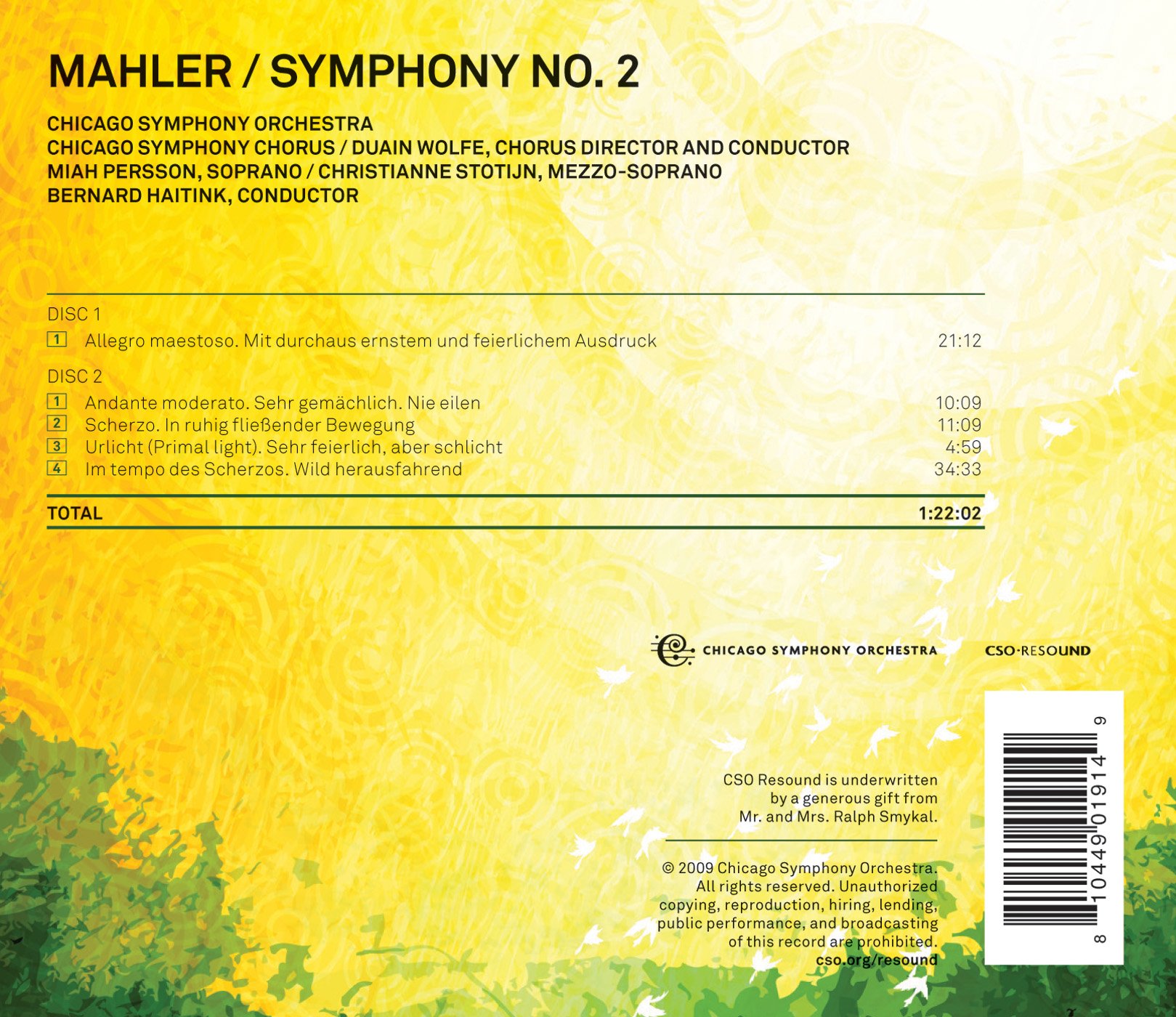
Mahler: Symphony No 2 Resurrection
D**S
Have enjoyed Abbado/CSO version for years
Have enjoyed Abbado/CSO version for years, like the Rattle/BPO for something different, but this may now be my favorite. Superb playing and recording. This surpasses Haitink's earlier versions of the work with Amsterdam or Berlin.
S**.
Stunning
Wow. I liked everything about this performance and the recording was outstanding.
H**T
A mild-mannered Mahler Second that erupts in a breathtaking ending
Haitink's ongoing Mahler cycle from Chicago has now described some familiar contours. On the whole it features relaxed tempos, superb execution, vivid sonics, and a surplus of nuance over energy. At eighty, Haitink isn't to be counted out; he's capable of considerable concentration. But his native temperament is often too middle-of-the-road for Mahler, whose music calls for the opposite of caution and refinement as one's main objective.Mahler performance is still overshadowed by Bernstein's temperament, which perfectly suited Mahler's, and those of us who want Mahler's tortured schizoid side, his childlike innocence and grim apocalyptic premonitions, his soaring idealism and sentimental nostalgia, feel cheated with less. Yet there's a marked divide here, and some notable Mahler interpreters, especially Boulez and Chailly, have carved out another path, where control, balance, and finesse predominate. That's the way of this new Mahler Second under Haitink, which bears little resemblance to Solti's famous Decca accounts, which were burning with vulgar excitement and drive. Boulez is cooler than Haitink, Tilson Thomas more mercurial, yet Haitink makes you listen to the wealth of subtlety he finds in the score. To be this civilized, he must ignore Mahler's directions at times, as when Mahler asks for the cellos and double basses to rip savagely into the opening theme -- here they are almost polite. However, the second movement minuet doesn't dawdle for all its lightness. The Scherzo moves with brisk momentum, if not the mischievous parody that Bernstein did so perfectly.For many listeners the Mahler Second is about the gargantuan payoff of the finale, ushered in by the hushed "Urlicht" solo. The young Dutch mezzo Christianne Stotijn has become a favorite of her countryman Haitink, and I like her very much, too, despite a growing tendency for her gorgeous tone to wobble. Her solo is quite moving and musical, with a real connection to the verse, and she's just as good in the duets to come in the finale.We're all on the edge of our seats anticipating the superlative Chicago brass and chorus. Both are reined in here, much as they are when Boulez conducts this work in Chicago. But the Chicago brass, even reined in, are more than up to Judgment Day. Valery Gergiev has a more interesting and riveting account on LSO Live, yet his brass section can't crack heaven open as this one can. The Chicago chorus always aims to be the best in the world, and their pianisssimo entrance is spine-tingling in its accuracy. For those who want the soprano soloist to enter with angelic seamlessness, Miah Persson is close to ideal, despite a touch of unsteadiness. In the final triumph of resurrection, Haitink goes for hushed majesty rather than visceral impact. Still, when the men of the Chicago chorus burst out in fortissimo a cappella, the effect is beyond compare. Sticklers for the score will also be happy to hear a prominent organ part.The finale tells the whole story of this performance, which swings between Haitink's mild manners and the Chicagoans eruptive excitement. There's no settling the difference, so what you hear is what you get.
G**M
beautiful drama
Simply the best.My previous favorite was Claudio Abbado's 1977 Chicago Symphony performance. Of course Bruno Walter set the benchmark (Sony). Simon Rattle put in an impressive performance while at Birmingham (1991). David Zinman's recent version (Zurich, 2007), as well as Pierre Boulez (Wiener) in 2006, are commendable.And then there is the truest Mahlerian at heart, Leonard Bernstein, in youthful vigor (Sony incarnation), and later DG extravaganza. If heart thumping on the sleeve is Mahler to you, it's Bernie, Bernie, Bernie. There is no denying the man as a monument of the musical life, a mountain of talent and skill.Mr. Haitink has captured a clarity and delicacy of precision like no other. Definitely not Mahler 2 as over-the-top drama. Listen to Mr. Haitink and hear Mahler 2 as a musical redemption. Beautiful drama like I've never heard.
P**Y
One of the Best Mahler 2 Peformances I've Listened
My favourite prior to this one used to be the Rattle-CBSO one (EMI). But from now on, this may be the more preferable one when it comes to Mahler's towering Resurrection symphony. Haitink is truly brilliant in expressing every minute details of this music in a consistent, stable, solid, and beautiful way. His tempo, rhythm, and timing seems meticulous. From the beginning to an end, Haitink commands a full control on this music - from pianissimo to fortissimo. Whenever the music exploded like a volcanic eruption, I couldn't help feeling goosebumped, particularly throughout the glorious finale. CSO's muscular rendering of Mahler in this recording was admirable. All in all, it definitely is another fine addition to already crowded Mahler's Second Symphony recordings.
ど**中
ハイティンク七転び八起き(笑)やっと出た会心の《復活》。
ハイティンクの付き合いはかれこれ四十年近い…聴きはじめたのはアムステルダムの若き常任指揮者の頃…彼の一度目のマーラー全集で《4番》《大地の歌》は今でも愛聴盤です。ところが、それ以降、何だか凡演の山を一人築き上げ…《復活》だけで七枚もの媒体を出してる(笑)…シカゴに呼ばれ《3番》がまた凡演(私は《3番》はハイティンク向きな曲じゃないと思います)。性懲りもなく、またまた《復活》を録音している…これが凡演だったら二度とハイティンクは買わないと心に決めましたが…第一楽章の冒頭で「あいたたた…」と悪い予感がしたのですが、最初の強奏でシカゴ響打楽器隊のスイッチが入り自発性が爆発…以降、ハイティンクの棒より突っ込み気味で緊張感があります。第二楽章も同様で、最初は何てことない、いつものハイティンクなんですが…徐々に熱を帯びてゆくのです。多分…全体の演奏時間も当初、ハイティンクが積算したより短いはず。第四楽章からフィナーレ、特に夜明けから合唱へと盛り上がるメラメラと燃焼する様は正に圧巻です。ソリストお二人も素晴らしい!いつも、ハイティンクと一緒のファンネスより、情感溢れる説得力あるアルトと、若々しいソプラノのコントラストは美しい。支えるシカゴ響合唱団は、いつもながらパワフルで纏まりも抜群に良い。これは、エンディングを強打の連続で締め括るのかと思いきや…もぅキッチリと楽譜通りに丁寧に終わります…んー…ハイティンクの生真面目さには脱帽するしかない。でもまあ…名演でしょ。
H**Y
Un disque pour Audiophile Mélomane
Insuffisant pour les uns, grandiose pour les autres, le moins que l'on puisse dire après la lecture des critiques glanées ça et là, c'est que le cycle Mahler entamé par Bernard Haitink et le Chicago Symphony Orchestra ne laisse pas insensibles les oreilles qui s'y aventurent. Des quatre volumes jusqu'ici publiés, celui-ci est assez représentatif de l'état d'esprit qui habite la nouvelle intégrale du chef néerlandais. Réalisée sur les bases d'enregistrements de concerts donnés à l'automne 2008, cette Symphonie n° 2 traduit magnifiquement bien les choix opérés par le maestro, aussi bien au niveau des tempos - quelle maniaquerie -, qu'au niveau des timbres et des textures orchestrales. Particulièrement attentif aux détails, il la prospecte jusqu'au plus profond de son intimité. Ainsi, son interprétation va bien au-delà des contours qui nous étaient jusqu'alors familiers. Elle manifeste une très grande sensibilité, un sens du raffinement que bien des versions plus démonstratives semblent malheureusement ignorer. Là où d'autres cherchent dans cette musique un motif d'engagement physique, Bernard Haitink y trouve une raison de serment moral. Doué pour révéler le soyeux et la transparence du tissu orchestral, il peut l'être aussi lorsqu'il s'agit de solliciter la puissance de ses pupitres. Au moindre de ses souffles, les braises les plus tièdes peuvent se transformer en un immense brasier. Son style est confessé avec une telle influence - une conviction si forte et pourtant si sereine - qu'on ne pourra plus s'empêcher d'y faire référence, qu'on soit volontaire ou contraint. Toujours au chapitre des louanges, ajoutons que comme pour les volumes précédents, l'auditeur dispose de conditions sonores tout à fait exceptionnelles. Bénéficiant d'une très bonne acoustique, le preneur de son nous gratifie d'un enregistrement en trois dimensions. Les parties vocales et instrumentales s'expriment sans brouillage, avec un naturel qui sent bon le concert, la présence du public étant, quant à elle, totalement imperceptible.
G**É
UNE VERSION INOUBLIABLE
Haitink est très certainement l'un des plus grands mahlériens actuels, il partage ce privilège avec quelques autres de ses confrères, car malgré la pléthore, le club des grands interprètes de Mahler s'avère plutôt fermé. Cette symphonie est l'une des plus difficiles et des plus abouties (même par rapport à la huitième) elle exige tout d'abord un orchestre de premier ordre (celui-ci est l'un des cinq meilleurs du monde, je ne citerai pas autres car on les connaît sur le bout des doigts) ou tous les premiers pupitres sont déjà en soit des solistes confirmés. Cette symphonie avec Haitink s'ouvre littéralement vers la lumière, déjà les angoisses du compositeur sont perceptibles et le chef les traduit admirablement, dans un discours symphonique d'une subtilité étonnante. Avec l'âge, le discours de Haitink est plus creusé, plus réfléchi, plus spontané que dans ses précédentes versions. La voix de Miah persson est toujours aussi belle.Cette version est vraiment magnifique !
B**Y
Un malherien authentique.
Ce double cd propose l'un des ultimes témoignages du mandat de co-chef principal du Chicago Symphony Orchestra de Bernard Haitink avant qu''il ne cède la place à Ricardo Muti.Excellente interprétation live, un peu en dessous de l'exceptionnelle réussite des mêmes acteurs dans les 3ème et 6ème symphonies du compositeur autrichien (même label CSO Records).Rappelons que l'on peut trouver et légitimement préférer au moins 5 (!)autres enregistrements de la même oeuvre par Haitink : en studio avec le Concertgebouw (1968) et le Philharmonique de Berlin (1993); live avec le Concertgebouw (1984), avec Berlin (1993) et avec la Staatskapelle de Dresde (concert de 1995 commémorant les cinquantes ans du bombardement de Dresde).La conception sobre rend pleinement justice à l'émotion qui doit sourdre d'une telle oeuvre, sans en accentuer les possibles outrances.
Trustpilot
3 days ago
2 weeks ago