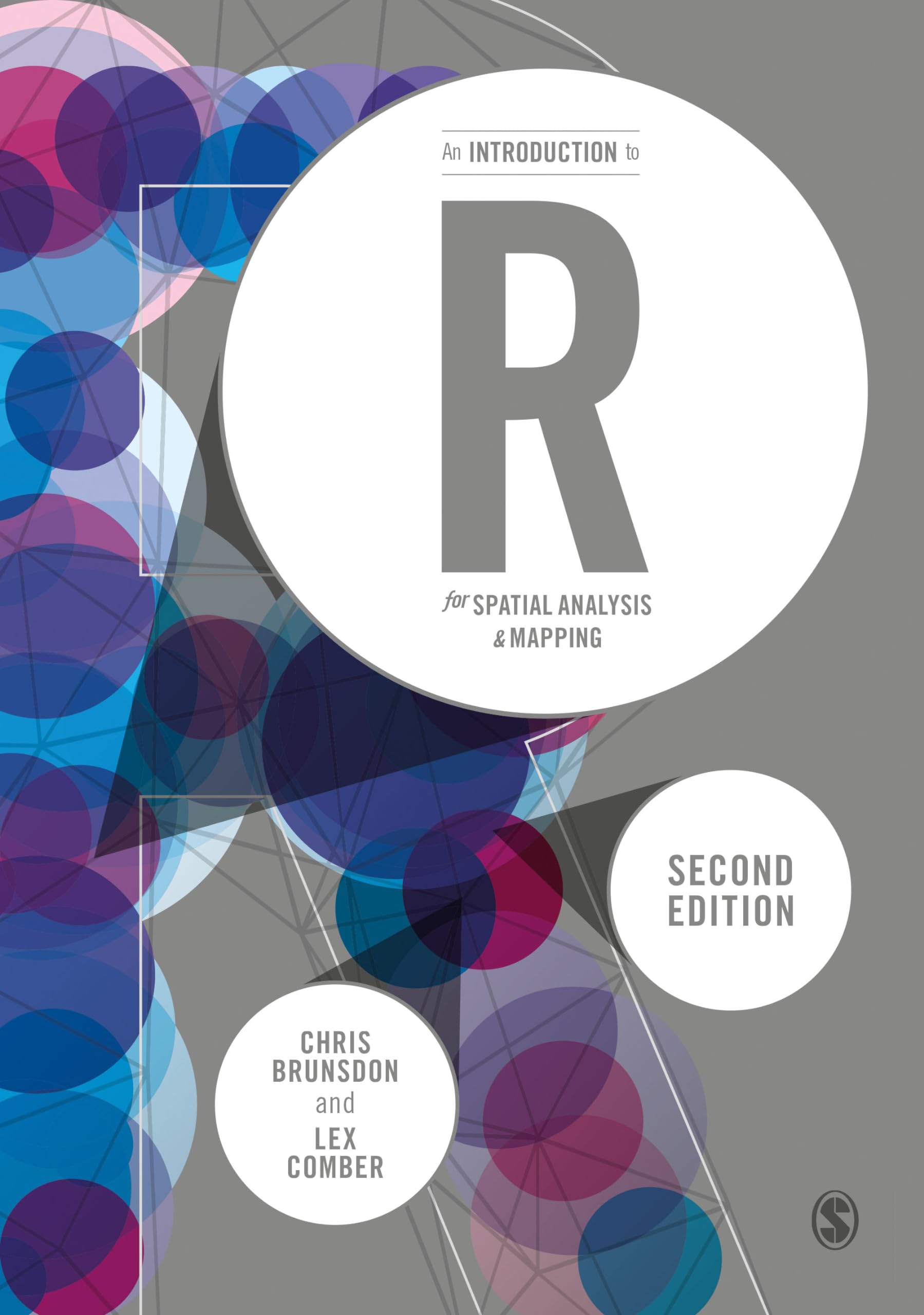
Buy An Introduction to R for Spatial Analysis and Mapping (Spatial Analytics and GIS) on desertcart.com ✓ FREE SHIPPING on qualified orders Review: Good book so far, aimed at beginners - Ordered this book for a graduate level spatial analysis class. So far, I am enjoying this book. The book itself says it is written for a reader with no experience in either R or spatial analysis which fits my description. It is easy to read and follow. I hope it continues to be helpful for the rest of my semester. Review: very easy to learn R - So many people are learning R as a requirement for their research, both in school and in work. This is both a great intro to R and it's implementation and use case for spatial analytics. Very clearly written and easy to understand regardless of your experience with programming
| Best Sellers Rank | #741,419 in Books ( See Top 100 in Books ) #47 in Introduction to Sociology #117 in Regional Geography #360 in Social Sciences Methodology |
| Customer Reviews | 4.2 4.2 out of 5 stars (64) |
| Dimensions | 6.69 x 0.79 x 9.53 inches |
| Edition | Second |
| ISBN-10 | 1526428504 |
| ISBN-13 | 978-1526428509 |
| Item Weight | 1.43 pounds |
| Language | English |
| Part of series | Spatial Analytics and GIS |
| Print length | 336 pages |
| Publication date | January 10, 2019 |
| Publisher | SAGE Publications Ltd |
C**S
Good book so far, aimed at beginners
Ordered this book for a graduate level spatial analysis class. So far, I am enjoying this book. The book itself says it is written for a reader with no experience in either R or spatial analysis which fits my description. It is easy to read and follow. I hope it continues to be helpful for the rest of my semester.
B**D
very easy to learn R
So many people are learning R as a requirement for their research, both in school and in work. This is both a great intro to R and it's implementation and use case for spatial analytics. Very clearly written and easy to understand regardless of your experience with programming
J**E
Reasonable starting point
Decent handbook for many functions, but lacks GWR
C**K
Excellent text
As the title of this review says... this is an excellent text. It provides everything you need to know to use R for spatial analysis and mapping. I especially liked the presentation on ggplot which is new in this edition. This volume is both accessible and comprehensive.
E**A
outdated, boring, not engaging, not providing explanations
Do not buy it if you are new to both coding and spatial analysis. Contains super vague explanations. Though the authors acknowledged that packages can become outdated they did nothing to make it usable. Packages got deleted while the code still incorporates those deleted datasets through the chapters. Not worse $40 - the formatting and colors are awful, cannot see anything (extra super small font and light colors). I wish I could return it. Worse book on R so far.
J**N
Looks like it was printed on a printer running out of coloured Ink
The print quality on this book is poor, so poor in fact I couldn't be bothered struggling to read the coloured text. It looks like it was printed on a printer that had almost run out of ink. I'm sure the content is good, if you could read it. The microsized font didn't help either. Were the publishers hard up for cash and used their mother's home printer. Pity. I threw it in the rubbish bin and it was an expensive book.
A**R
Many errors in the text
I am finding a lot of apparent errors in the text and, most importantly, in the answers to the self-test questions. Answer keys are incomplete and often do not work in any version of R.
B**E
Teaches very specific skill sets for R for mapping and spatial analysis. Code font is small.
So if you are in charge of gerrymandering, this is the book for you. Not joking here. This book teaches very specific skill sets for R for mapping and spatial analysis. This is an instructional book, meant to teach you, not a set of instructions to blindly follow. As a teacher, I am impressed with the careful job the authors do to outline the concept, give practice, and extend the idea. I have one complaint, and I am taking a star for this, the code is printed in small (maybe 9 point?) and light font (see photo). In spite of what you might think some of us using this are not in our twenties, and it is difficult to read. The directions are in perfectly readable font. I am not going to go into the advantages and disadvantages of R here, because if you are considering this book, you already know. Instead I will list the chapters so you can see if this covers what you need: Intro: (basics about getting and running R) Data and Plots Basics of Handling Spatial DAta in R Scripting and writing functions in R Using R as a GIS Point Pattern Analysis using R Spatial Attribute Analysis using R Localized Spatial analysis R and Internet Data Epilogue. This is a book to really develop your programming skills if you take the time to work through it.
E**O
Il libro è realmente una guida per chi inizia. Presenta le cose con completezza rinunciando a pochissimi dettagli e inviatando ripetutamente e in modo efficace a sperimentare le soluzioni. Alla fine viene voglia di andare avanti con cose più avanzate e questo è il vero scopo di un libro introduttivo. Bravissimi gli Autori. Hope in a third edition. Best.
Y**R
I had the first and the second version of this book! It introduces the basic methods to analyse spatial data which is very useful! highly recommend. the instruction is detailed so that it is easy to follow step by step.
A**A
Fantastic book. It was what I was looking for
K**R
I have been meaning to extend my R skills into spatial mapping and analysis for a while. I had the first edition of this book, but since the development of new data classes in R it seemed essential to get the new edition. It also doesn't help that the companion website for the first edition that included corrections is no longer available. The book itself is excellent and covers all the major topics. The text is generally clear and the illustrations are good. I only have two gripes. Firstly, the code snippets in this edition are printed in a font so small that they are almost impossible to read (smaller than the first edition I think), and not helped by the colour choices. Given this is a "teach yourself" book that relies heavily on code snippets, this is a PITA. Secondly, the ggplot2 package, which is widely promoted as creating "elegant graphics", actually creates (IMHO) graphs full of unnecessary chart junk (see anything written by Tufte on the subject). It is possible to turn this junk off, but it takes a lot of code (and headaches) to work out how. Even the "classic" theme is not devoid of it. One of the strengths of R was the fact it gave one the ability to create much better graphs than Excel; ggplot2 allows one to excel Excel in ugliness and pointlessness.
Trustpilot
1 week ago
3 weeks ago