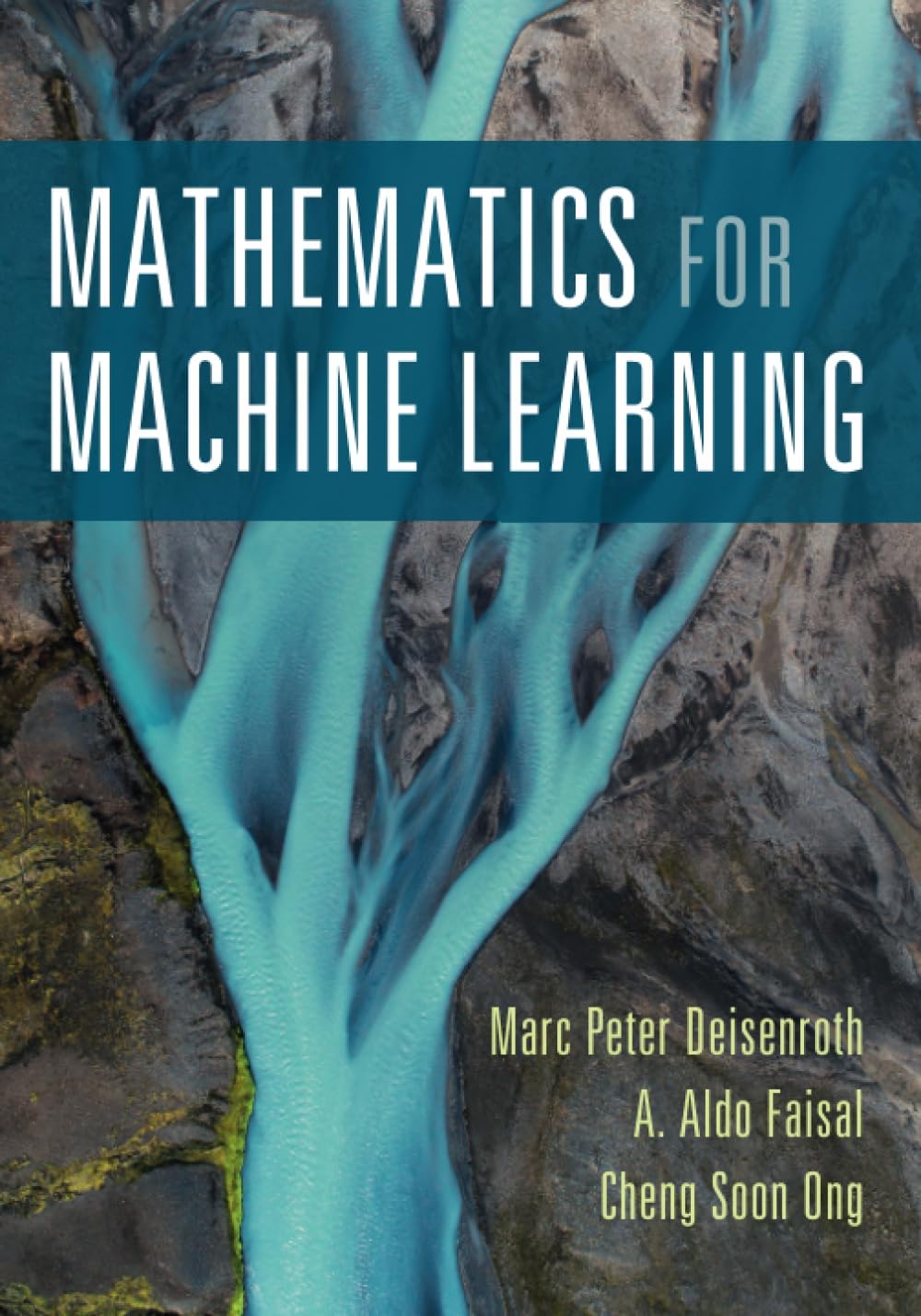

Mathematics for Machine Learning [Deisenroth, Marc Peter] on desertcart.com. *FREE* shipping on qualifying offers. Mathematics for Machine Learning Review: Wonderfully illustrated, welll laid out, great website and extra content - If you already have a background with linear algebra, calculus, statistics, then this will be a nice refresher applied to the subject in question, machine learning. In that regard, it serves perfectly as a way to organize your study to get into AI/ML in a deeper way. Certainly deeper than from a purely user perspective. If you don't have a background with linear algebra, calculus, statistics, it'll still provide a well organized studies plan for you to dive deeper. It cannot, of course, be a textbook for these areas, it would take hundreds, thousands of pages to do so, and that's clearly not feasible. What it does is introduce you to some concepts, refresh them, or refer you to further studies where there is a need to dive deeper in certain topics. The book is clearly organized, well illustrated. For that alone I'm thankful, for many mathematics textbooks, even the ones targeting the professional mathematician, make the fatal mistake of assuming the reader finds images insulting. They're not. Images help you organize thoughts visually, geometrically, providing important insights. For that alone, the content and organization, I would give the book 5 stars. The examples are well laid out, the cases well illustrated, giving room for the reader to breathe without being crushed by a dense monolith of rendered equations. Where it exceeds and stands above others is that the companion website provides, freely, the PDF of the book, an errata, instructor solutions to the exercises, and Jupyter Lab notebooks. While other publishers would try to rob the customer blind by offering each of these as a separate product, for a hefty sum naturally, this publisher thought it would best serve the reader to have access to all this content for free. Naturally, in this day and era, seeing someone focused on spreading knowledge for the sake of science and knowledge is commendable, and I cannot give me more than 5 stars sadly, for I would. If you read it this far, this is a no-brainer. Visit the website, take a look at the PDF, buy it, so that you can have the version with you for your daily studies, and the PDF for that morning reading on the tablet. The Jupyter notebooks make exploration fun and interesting, even if you're not experienced in the field. It does not assume you are an expert in these areas, though naturally, it would benefit you greatly if you have experience or if at least you have some textbooks on linear algebra and some knowledge of differential, integral calculus. To the authors, congratulations, and to the publisher, may you have a thousand years of prosperity and good fortune for making the auxiliary content freely available and in such a open and honest manner. Bravo. Highly recommended. Review: Incredible Resource - I had been looking for a book to bridge the gap between implementing machine learning code on the granular level and understanding it from a theoretical perspective and the search wasn't going well. Lots of other books that I tried before finding this one promised to help programmers become better mathematicians (or at least show them the math they need to learn in order to achieve that goal) but would almost always just provide code without context, or run through some incredibly basic, introductory level math without explaining at all how it connects to the various machine learning algorithms you'll be implementing as a programmer. This book, however, takes the math seriously, and is incredibly direct and efficient in the introduction of new, relevant topics in calculus, linear algebra, and probability and statistics that you'll need to know if you want to truly understand the libraries you're using. I find myself reading a section in the book, going back to a "dedicated" textbook on the subject at hand - linear algebra or calculus or probability and statistics - and further studying the material, and then going back to Mathematics for Machine Learning to make sure I understand the topic better. This is the exact learning flow that I wanted, and the book delivers. Can't recommend enough!

| Best Sellers Rank | #32,103 in Books ( See Top 100 in Books ) #7 in Computer Vision & Pattern Recognition #29 in Computer Science (Books) |
| Customer Reviews | 4.6 out of 5 stars 993 Reviews |
L**S
Wonderfully illustrated, welll laid out, great website and extra content
If you already have a background with linear algebra, calculus, statistics, then this will be a nice refresher applied to the subject in question, machine learning. In that regard, it serves perfectly as a way to organize your study to get into AI/ML in a deeper way. Certainly deeper than from a purely user perspective. If you don't have a background with linear algebra, calculus, statistics, it'll still provide a well organized studies plan for you to dive deeper. It cannot, of course, be a textbook for these areas, it would take hundreds, thousands of pages to do so, and that's clearly not feasible. What it does is introduce you to some concepts, refresh them, or refer you to further studies where there is a need to dive deeper in certain topics. The book is clearly organized, well illustrated. For that alone I'm thankful, for many mathematics textbooks, even the ones targeting the professional mathematician, make the fatal mistake of assuming the reader finds images insulting. They're not. Images help you organize thoughts visually, geometrically, providing important insights. For that alone, the content and organization, I would give the book 5 stars. The examples are well laid out, the cases well illustrated, giving room for the reader to breathe without being crushed by a dense monolith of rendered equations. Where it exceeds and stands above others is that the companion website provides, freely, the PDF of the book, an errata, instructor solutions to the exercises, and Jupyter Lab notebooks. While other publishers would try to rob the customer blind by offering each of these as a separate product, for a hefty sum naturally, this publisher thought it would best serve the reader to have access to all this content for free. Naturally, in this day and era, seeing someone focused on spreading knowledge for the sake of science and knowledge is commendable, and I cannot give me more than 5 stars sadly, for I would. If you read it this far, this is a no-brainer. Visit the website, take a look at the PDF, buy it, so that you can have the version with you for your daily studies, and the PDF for that morning reading on the tablet. The Jupyter notebooks make exploration fun and interesting, even if you're not experienced in the field. It does not assume you are an expert in these areas, though naturally, it would benefit you greatly if you have experience or if at least you have some textbooks on linear algebra and some knowledge of differential, integral calculus. To the authors, congratulations, and to the publisher, may you have a thousand years of prosperity and good fortune for making the auxiliary content freely available and in such a open and honest manner. Bravo. Highly recommended.
A**R
Incredible Resource
I had been looking for a book to bridge the gap between implementing machine learning code on the granular level and understanding it from a theoretical perspective and the search wasn't going well. Lots of other books that I tried before finding this one promised to help programmers become better mathematicians (or at least show them the math they need to learn in order to achieve that goal) but would almost always just provide code without context, or run through some incredibly basic, introductory level math without explaining at all how it connects to the various machine learning algorithms you'll be implementing as a programmer. This book, however, takes the math seriously, and is incredibly direct and efficient in the introduction of new, relevant topics in calculus, linear algebra, and probability and statistics that you'll need to know if you want to truly understand the libraries you're using. I find myself reading a section in the book, going back to a "dedicated" textbook on the subject at hand - linear algebra or calculus or probability and statistics - and further studying the material, and then going back to Mathematics for Machine Learning to make sure I understand the topic better. This is the exact learning flow that I wanted, and the book delivers. Can't recommend enough!
E**C
Brilliant and Precise
The book is the missing piece between books like Artificial Intelligence: A Modern Approach and the mathematics you require to take such an undertaking. The authors do assume very little prior knowledge from the reader, but it t is recommended that you've had exposure to some of the mathematical topics prior to reading the book. But don't let that stop you if you're a beginner: you'll have to make a few detours to grasp some terms and such. Having said that, a course on single variable calculus ought to be under your belt. That's basically the only prerequisite. The explanations are clear, and the book is designed to bring clarity and lucidity onto the topics, not send the student on an endless pit of proofs and rigor.
M**L
A Book Struggling with its Identity
Don't get me wrong, this is a really good book. But this is a book that's stuck somewhere between a Mathematics book and a Computer Science book. Having studied the mathematics in ML during college, I'm already familiar with the topic discussed in the book. I'm mainly reading it as a refresher of linear algebra and calculus that I haven't used in years. It does a good job laying out necessary mathematical concepts, but it doesn't do as good of a job at providing proofs/explanations to a lot of the properties and extensions. For example, the book gives a good algebraic definition of orthogonality in terms of vectors and subspaces (inner product of the vectors/subspaces in question equal 0). However, in the next section about function orthogonality, the book just says "functions can be seen as vectors" and provides a definition in terms of a definite integral. The book didn't provide reasoning for such a jump from inner product to integral, nor did it provide explanations or intuitions for the upper and lower bounds of the integral. There are many more examples where the book doesn't provide proofs/explanations and hurries on to introduce new concepts. The first few chapters alone is definitely enough for you to understand the concepts of the later chapters, but you WILL need to read dedicated mathematics textbooks (like the ones they pointed out in the "further readings" sections at the end of each chapter) if you want to form a sound mathematical foundation. On the other hand, it did a decent job introducing many important algorithms in ML and the mathematics behind them, but it also lacks many key ideas important to ML. One would expect a book focusing on the mathematical side would be fairly theoretical on the subject of learning, but it doesn't cover fundamental theories in learning such as PAC learning, VC dimensions, No Free Lunch theorem, etc. I think the "Understanding Machine Learning: From Theory to Algorithms" book by Shai Shalev-Shwartz and Shai Ben-David is a much better read on those subjects. Overall, it's a good book to have, especially when you need to a quick refresher on the mathematics or needs some help understanding the mathematical intuitions behind popular ML algorithms. What the book is not, is a beginner-friendly machine learning textbook for those who don't already know some linear algebra.
T**N
Excellent book for reviewing math materials
This book is excellent for brushing up your mathematics knowledge required for ML. It is very concise while still providing enough details to help readers determine important parts. This is my go-to if I need to review some concepts or brush up on my knowledge in general. I wouldn't recommend this book if you have absolutely no prior math experience though as it can be hard to digest and sometimes they would skip parts here and there in proofs and examples. Especially for the probability section, the concepts will be very hard to grasp without prior knowledge
A**N
Awesome book but it can scare the beginners :)
Great book who wants to understand the maths behind the ML models, but some parts are rocket science :). I would definitely recommend this book to people in academia or to whom who has enough time to dive deep into theoretical aspect of the ML.
M**)
Great book for beginners!
Even though I can get a free e-copy, I still like the paperback version because I flip through it occasionally. This book sketches a clear big picture of the knowledge tree for ML and provides necessary build blocks to help you build solid foundations in preparation for practical ML. You have to be aware this paperback version doesn't come with solutions. One of my reason to buy this is for the solutions. It turned out that only instructors can request solutions from the press company.
P**N
This is how math should be taught to CS majors
In college, I was bored out of my mind during Linear Algebra, Multivariable Calculus, and Statistics courses. I wish the concepts would be introduced in the way they are in this book. For example, partial differentiation and gradients are explained in terms of neural network weight optimization / gradient descent. This book is especially valuable if you know the basic intuition behind machine learning and neural networks, and also have a basic intuition behind the math, and want to combine this intuition with a formal mathematical understanding.
Trustpilot
4 days ago
1 week ago