🪚 Unlock your woodworking potential—build skills, projects, and bragging rights!
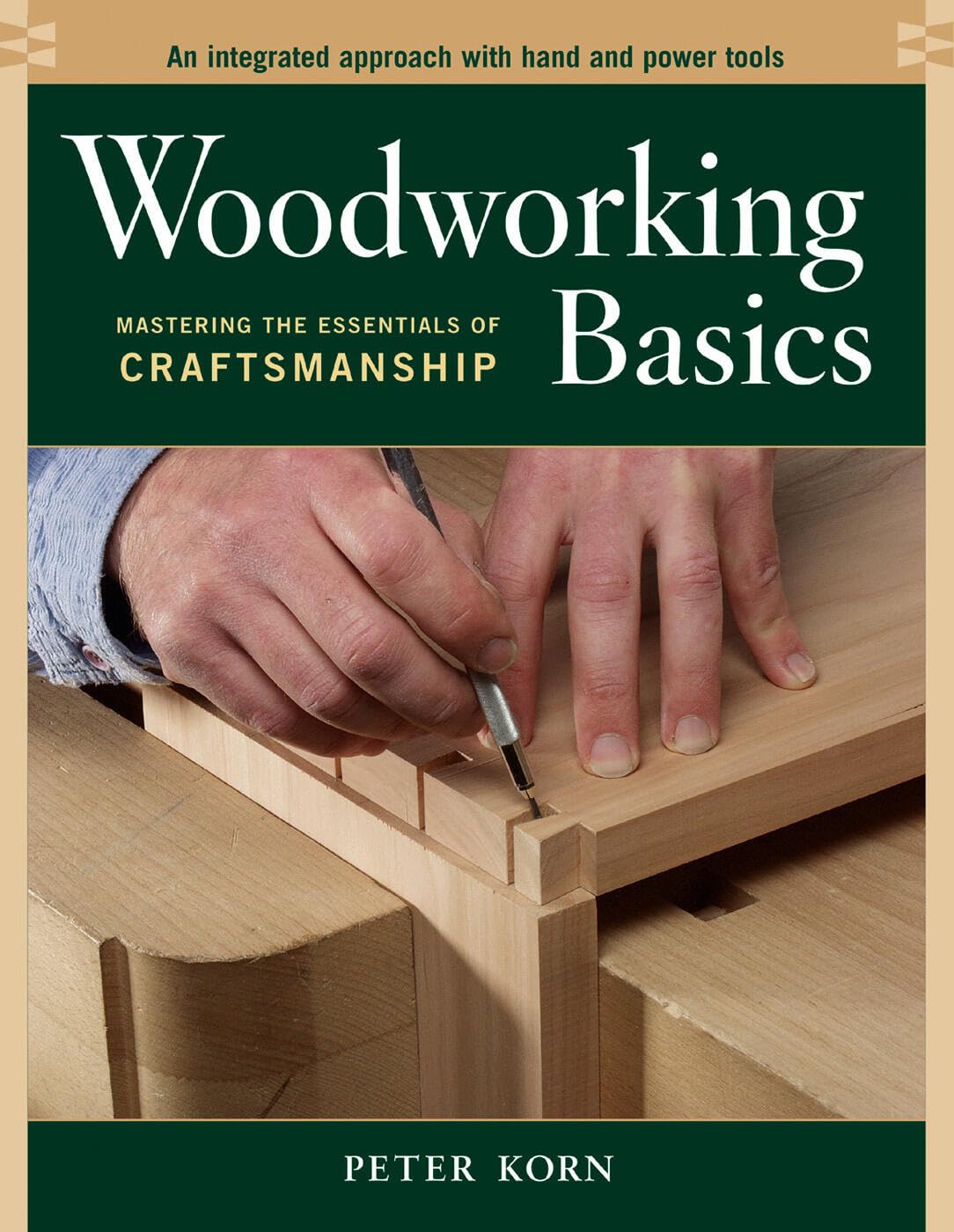
Woodworking Basics: Mastering the Essentials of Craftsmanship by Peter Korn is a highly rated, comprehensive guide that combines detailed tool explanations with practical, skill-building projects. Perfect for aspiring woodworkers ready to elevate their craft, it ships same day if ordered before noon and comes with guaranteed packaging and hassle-free returns.
| Best Sellers Rank | #242,657 in Books ( See Top 100 in Books ) #124 in Carpentry #278 in Woodworking Projects (Books) #345 in Do-It-Yourself Home Improvement (Books) |
| Customer Reviews | 4.6 out of 5 stars 707 Reviews |
K**C
thorough introduction to woodworking
great workbook, tool explanations, bench project, well written.
L**R
Great Sill Building Class in a Book
Well thought out and presented, it is not only a reference book full of information it is also a skill building class taking the reader through various tasks that will be used in a couple of projects later on in the book. The projects are useful, elegant and as a skill building project they incorporate the techniques in the book providing practical application of some fundamental techniques. I purchased about $50 of additional tools that the projects could require (you don't have to have them but a work-around can be tedious) so if you are just starting, be prepared for the additional expense. Not a great deal of money but the book assumes that you already have some fundamental tools either powered or non powered. Also a mortising marking device is not a common item to me, but I now own one so i could complete the projects accordingly. The basics are really essential for designing and building you own furniture. I am only a third of the way into the first project but having read the book prior to starting I see that this is a great, fun way to learn and build up those wood working creds.
D**S
Good, informative book
Good book. Using it for a woodworking class. Informative, though current edition is old.
E**Z
Great
Amazing
S**Y
Perfect 101 book for Beginners
I took a beginning woodworking course a long time ago, but have decided to refresh my interest. Korn's book is almost identical to the structure and pacing of instruction from my course. His project based instruction and step by step approach is exactly what newcomer's need. I also like Korn's lack of pretense when presenting tools or techniques. Many books these days wax the "poetic" of woodworking with seductive images and effusive text, being little more than a showcase of very expensive premium hand tools. Korn appears to take a more modest (and affordable) approach with essential hand tools. Although much of the machinery shown in the book may be beyond a beginner's pocket book, the alternative hand tool approach is well within reach and will drive home the fundamentals of woodworking more than machine milling will. The first 70 pages introduce the reader to wood, joinery and (power and hand) tools. The reader learns a great deal without being intimidated by too much detail. The sections are a bit terse (particularly sharpening), but the simpler introductions are appropriate to the scope of the book. There are other books that specialize in the topics of advanced machine use, hand planes and sharpening. Korn's book has just enough to get you going without making you feel it is too complicated to proceed. The first project, milling a board four square, is a fundamental task of woodworking that deserves the attention it gets in this book. Korn does a superb job of providing step-by-step instruction using hand tools or power tools. For me, Sharpening was the first "project" in the WW class I took since it is also a fundamental. The second and third project is to take the boards you dimensioned and do some basic joinery (before working on any furniture). First, the basic mortise and tenon and then the through-dovetail joint. Joinery is also a fundamental, and these particular joints are the most widely used. Korn takes us step-by-step through the process with plenty of clear photographs showing the technique. The milled boards are long enough that the reader can practice the joints several times. Each time your joints will get better, and you will gain valuable experience and confidence. The last 80 pages include two small projects, a handsome stool and a side table. These projects are big enough to introduce several more fundamentals without being too complex that the reader will never finish. The stool introduces half-blind dovetails, pinned tenons, glue-up procedure, and basic finishing. The side table introduces basic carcase and drawer/panel door construction. Again, all steps are well documented with plenty of photographs.
J**O
Perfect introduction, very enjoyable read
First I need to point out that I am an armchair woodworker, unfortunately I have not had the pleasure (yet) to do the various exercises/projects. This was my first woodworking book. The author has a vast experience not only in woodworking, but also, and perhaps more importantly at this level, in *teaching* woodworking. He can explain the various concepts and techniques very eloquently, precisely and concisely. The descriptions are so accurate that it feels like you are actually seeing it done - no, doing it yourself, even though you are (like I was) sitting in a train. The pictures are also excellent, and the balance between text, pictures, drawings and sidebars denotes first-class editing. From a macro level, the book is also carefully structured. The first part describes the properties of wood and how they affect woodworking. Then machines are explained one by one, followed by hand tools (I would have done it the other way around, but never mind). After that, the student is taken through a number of basic exercises, in many cases giving various choices of hand tools and machines. Finally, there are a couple of projects. Be warned, reading the book takes some effort on your side. Especially if you are unfamiliar with technical terms, which are always introduced before they are used in context, you will have to look them up again in the index, which is by the way complete and functional. The author's writing is packed with information (which is good), and he is explaining difficult operations so you sometimes have to read the same paragraph twice to understand how to do things properly. When later projects build on previously-learnt material, the reader is referred to the specific page instead of repeating the explanation. Five stars, well deserved.
K**P
This is not a stand along Novice woodworking book.
This book is not bad. It would be a great supplement to the class. It has nice projects. However a lot of the details a new woodworker who does not have someone to learn from are missing. For example, in one section it's titled 'know your glues.' The author gives limited detail on yellow glue, but only mentions in brief the other types of glues in a matter that only leaves the novice hanging on how to identify a good white, yellow, epoxy, or many of the other types of glue. In another section the author talks about using power tools and things he would recommend, but not the details. For example a router is a great tool for finishing edges and cutting datos,' but the author doesn't help you decide which type of router would best fit ANY type of woodworker. For example something like 'the cabinet maker will have something like these 3 routers, while the hobbyist should start with X router.' Again, the very important details for the novice are left out-- and this book is for novices. Also I like the recommended progressions presented, but it really isn't that helpful in this case. If it was 1993 and we didn't have endless resources at our finger tips on the internet for projects, I could see how this could be more useful. Also from my novice perspective, the project is the source of creativity and interest. if it's already set for me then I lose the desire. More useful than having 30 pages of plans on end table construction would be specific joints and construction method's used for all types of cabinet building, including the specifics on how to execute them, along with tips from the pro. This book along will not help you get started in woodworking. Mark Spagnuolo's book Hybrid Woodworking is much better at guiding the Novice through the sea of expensive tools and techniques for the beginner and has plenty of information on advanced woodworking. There is a slight shift in philosophy towards power tools from Peter Korn, but only slight. And those small differences can easily be found on the internet if you desire to lean more towards the hand tool methods. I would also recommend Terrie Noll's Joint Book: The Complete guide to Wood Jointery as a benchtop resource for helping remember the joints and methods for fine woodworking.
P**K
Good information, selfish author. Don't follow all of his advice.
Good information for new Woodworker's or for Woodworker's who want a refresher. One complaint I have at the author. He says to try to find a place you can pick through the stacks of wood and select your own boards that is the way he does it. He then complains about the quality of even FAS wood not being very good. As proof he offers that he once picked through a thousand feet of cherry and only found three "excellent boards". Guys who will pick through a thousand board feet and then buy three lousy boards are the problem. The reason often the only thing that is left is twisted and knotty are because of guys like this author. Wood is a natural product. You take the good with the bad then you cut around the imperfections or better yet hide them on the inside. If everyone only bought the best boards, think how many more trees would need to die in order for everyone to fulfill his wood needs. Now I'm by no means a tree hugger but I don't think wasting is right and I don't think leaving all the bad stuff for the next guy is right either. I am guessing this author is a democrat since he has no ethics about what he leaves in his wake or the amount of time he takes in the store being in the way while other people may want to buy lumber, but by the way he acts about cutting trees until he finds the perfect one you would never know it. When I buy boards I take pretty much what is on top and buy extra so I can deal with the imperfections in a natural product. I get my stuff, get out of the way, and leave the pile in good shape for the next customer so it doesn't fall on top of him. I request my fellow woodworker's behave in a similar civilized manner.
Trustpilot
2 months ago
1 day ago