Some deliveries may take a little longer than usual due to regional shipping conditions.

DOWNLOAD THE APP


Customer Services
Copyright © 2025 Desertcart Holdings Limited
DOWNLOAD THE APP
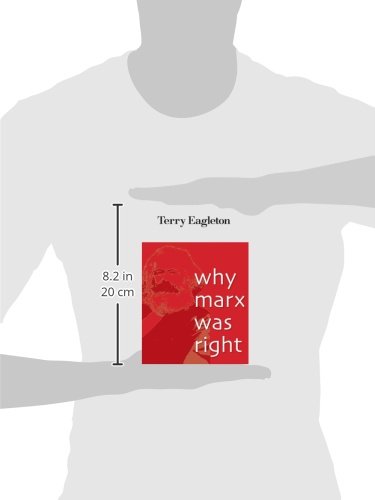
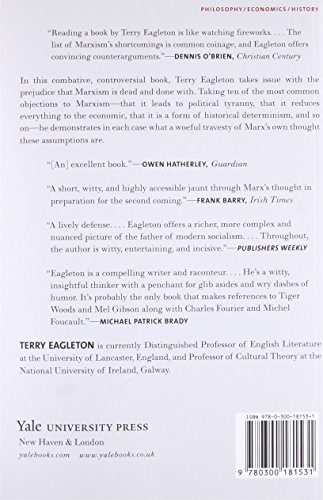
Why Marx Was Right [Eagleton, Terry] on desertcart.com. *FREE* shipping on qualifying offers. Why Marx Was Right Review: A Great Defense Of Marxism - Terry Eagleton's "Why Marx Was Right" is a wonderfully written and accessible introduction to the thought of Karl Marx. It is fashionable to dismiss Marxism as "outdated" or "irrelevant" as it pertains to contemporary economic and political problems. Eagleton provides a much needed correction to this ignorant viewpoint. Eagleton takes the many objections voiced by the enemies of Marxism (e.g. Marxism is "great in theory" but only leads to bloodshed; Marxism is utopian; Marxism reduces everything to economics; Marxism is deterministic, etc.) and demolishes them one by one. Here is Eagleton's take on those who hypocritically condemn Marxism as "bloodstained": "Modern capitalist nations are the fruit of a history of slavery, genocide, violence and exploitation every bit as abhorrent as Mao's China or Stalin's Soviet Union. Capitalism, too, was forged in blood and tears; it is just that it has survived long enough to forget about much of this horror, which is not the case with Stalinism and Maoism." (p. 12-13) Ever argue with someone who claims that socialism is an "unrealizable utopia"? Here's Eagleton's answer: "There is good reason that there can never be any complete reconciliation between the individual and society....Marx's claim in the Communist Manifesto about the free self-development of all can never be fully realized. Like all the finest ideals it is a goal to aim at, not a state to be literally achieved....Those who scoff at socialist ideals should remember that the free market can never be perfectly realized either...Some of those who claim that socialism is unworkable are confident that they can eradicate poverty, solve the global warming crisis, spread liberal democracy to Afghanistan and resolve world conflicts by UN resolutions. It is only socialism which for some mysterious reason is out of reach." (p. 87-88) These are only two of the many criticisms demolished by Eagleton. "Why Marx Was Right" is an entertaining and informative defense of Marxism and its relevance for modern humans. Highly recommended! Review: A Corrective for Those Who Pretend to have Read Marx - Terry Eagleton's book "Why Marx was Right" is a skillfully written, sometimes almost poetic, mis-titled political polemic. A more suitable title would capture Eagleton's remarkably well-informed effort to demonstrate that so much that is so often found horribly wrong with common misconceptions of Marxism is sharply at odds with everything that Marx ever wrote. "Why Marx was Not Wrong" or "Marx Never Said That" would be more suitable titles, but neither grabs the prospective reader's attention or has, for many, the shock value of "Why Marx was Right." Nevertheless, the primary purpose of Eagleton's book is to set the record straight and make clear that much of the nonsense often attributed to Marx represents a misreading or, more likely, a failure to read what Marx wrote, sometimes with Engels as like-minded co-author, over the course of his lifetime. Commonly, when an author comes to Marx's defense he or she is met with strident cries that when Marxism has been tried it has met with murderously disastrous results. Moreover, esteemed scholars such as Leszek Kolakowski and Eugene Genovese , Marxists in their youth, later concluded, no less polemically than Eagleton, that efforts to establish socialist societies were doomed not only to fail, but to almost certainly result in the tyranny and mass murder that befell Stalin's Soviet Union and Mao's mainland China. However, author's with these mid-career changes in mindset are typically loathe to acknowledge that Marx would have emphatically judged that Russia and its underdeveloped neighbors in the first decades of the 20th Century, and China in the late 1940's were among the poorest choices for a revolution that would have led to establishment of effective socialist societies. Marx's view of the conditions necessary for creation of socialism was that it be established in developed societies, not poor peasant domains ruled by a parasitic royalty or collections of barbaric war lords. In other words, in so far as Marx had a rudimentary prescription for development of a socialist society, it followed a requisite period of growth, industrialization, innovation, and diversification that typifies a mature capitalist social system. For better or worse, following Eagleton, the profit motive and its developmental outcomes necessarily laid the groundwork for emergence, gradual or with revolutionary suddenness, of a socialist society. Otherwise, there was too little to build on and too little to foster the development of human potential. Notice that in addition to admiration for the innovative and economically productive nature of capitalism, according to Marx the transition to socialism need not involve bloodshed. It may or may not, but the decisive factor was recognition on the part of the population -- not a revolutionary elite, but citizens in general -- that capitalism had reached a point where the unending pursuit of capital accumulation was more destructive than beneficial. For example, Anthony Giddens reports in his recent book Turbulent and Mighty Continent that fully half of the world's available capital is not invested in productive activity, the kind that would create jobs and promote social and economic development. Has capitalism backed off from what it has always done best? Is this evidence of its obsolescence? Given the foregoing observations, it's difficult to avoid thinking in terms of class, a concept once dismissed in the West as obsolete and reckoned in strictly cultural terms. It is clearly the case, however, that the capitalist mode of production is based on two fundamental classes, the one that owns and controls the means of production and finance, with members of the other, much larger class, working in whatever occupational positions capital makes available. Eagleton finds it useful, moreover, to recognize an intermediate middle class which, for the most part, is made up of members of the working class who are doing particularly well, at least for the short term. But the basic formulation is capital and proletariat. The questions that usually follow an account such as this unmistakably imply that Marx was a leveler who wanted to create a world where any differences among people, especially with regard to material resources, were summarily eliminated. However, Marx never wrote anything to suggest that he was a leveler or that he wanted to establish person-to-person homogeneity with regard to much of anything. In fact, you'll find just the opposite if you read his essay on "Primitive Communism" in the "Economic and Philosophical Manuscripts of 1844." Marx construed people, at birth, as possessing enormous potential for developing a broad range of talents. No two people were the same, and given that we have different interests and capabilities, the resources used by one would inevitably be more or less and different from the resources used by another. What Marx wanted was a society wherein self-actualization was more than just a quaint psychological concept from the 1940's that was kept alive by the authors of textbooks for undergraduates. Of course Marx wanted to eliminate the class-based society intrinsic to capitalism, but elimination of all material and other differences was sharply at odds with his perspective. As one who assumed that we are all capable of producing ourselves in a variety of satisfying ways through the expenditure of intelligence, talent, and effort according to our natural capabilities, one might surmise that we have the key to Marx's understanding of human nature, something Marx termed "species being." This is the position Eagleton takes, and he develops it beautifully. I think, however, that Eagleton goes too far when he denies that Marx thought that human beings at birth were cognitively blank slates or tabula rasa. As a materialist, meaning one who gives priority to experiential determination of the kind of people we find in any society, I think it makes a good deal of sense to invoke the blank slate metaphor. The potential for growth and development that Marx saw in each of us was promoted or thwarted, enhanced or diminished, realized or undercut by the social circumstances in which we lived. Capitalism created people whose life experiences made them combative, greedy, adversarial, demoralized, unnaturally limited ... simply by functioning according to its intrinsic, observable characteristics. A socialist society that did not provide a context within which human development was relatively unfettered by economic constraints was socialist in name only. Still, in spite the unflattering outcomes attributed to capitalism, it remained a necessary prerequisite to socialism. Capitalism provided socialism with its material foundation. It was only when the ethos of capitalism was overcome by a socialist point of view and socialist values that socialist society became possible. But how does one imbue men and women with a socialist perspective? The very term "socialist," much as with "communist," has become in the U.S. a laughably profane political epithet. Only when everyday experience with the material world persuades the citizenry that capitalism has run its course, constrains productivity, and makes a good life ever harder to achieve will socialism become a tenable alternative to things as they are. Given the current contradiction between prevailing anti-socialist mindsets in spite of deteriorating material circumstances, one can see why a transition from capitalism to socialism is so often dismissed as utopian nonsense. This, too, however, is something that Marx came to understand very well, and may help to explain why he never wavered in his commitment to the view that the nature of a genuinely socialist or communist society could not be precisely foreseen but had to emerge as a consequence of concrete historical development. In this and an impressive variety of additional ways, Eagleton gives compelling substance to the question "Was ever a thinker so travestied?"
| Best Sellers Rank | #1,617,424 in Books ( See Top 100 in Books ) #1,247 in Theory of Economics #1,865 in Communism & Socialism (Books) #3,723 in Political Philosophy (Books) |
| Customer Reviews | 4.4 4.4 out of 5 stars (171) |
| Dimensions | 5.25 x 0.75 x 8.5 inches |
| Edition | Reprint |
| ISBN-10 | 0300181531 |
| ISBN-13 | 978-0300181531 |
| Item Weight | 10.4 ounces |
| Language | English |
| Print length | 272 pages |
| Publication date | April 24, 2012 |
| Publisher | Yale University Press |
G**R
A Great Defense Of Marxism
Terry Eagleton's "Why Marx Was Right" is a wonderfully written and accessible introduction to the thought of Karl Marx. It is fashionable to dismiss Marxism as "outdated" or "irrelevant" as it pertains to contemporary economic and political problems. Eagleton provides a much needed correction to this ignorant viewpoint. Eagleton takes the many objections voiced by the enemies of Marxism (e.g. Marxism is "great in theory" but only leads to bloodshed; Marxism is utopian; Marxism reduces everything to economics; Marxism is deterministic, etc.) and demolishes them one by one. Here is Eagleton's take on those who hypocritically condemn Marxism as "bloodstained": "Modern capitalist nations are the fruit of a history of slavery, genocide, violence and exploitation every bit as abhorrent as Mao's China or Stalin's Soviet Union. Capitalism, too, was forged in blood and tears; it is just that it has survived long enough to forget about much of this horror, which is not the case with Stalinism and Maoism." (p. 12-13) Ever argue with someone who claims that socialism is an "unrealizable utopia"? Here's Eagleton's answer: "There is good reason that there can never be any complete reconciliation between the individual and society....Marx's claim in the Communist Manifesto about the free self-development of all can never be fully realized. Like all the finest ideals it is a goal to aim at, not a state to be literally achieved....Those who scoff at socialist ideals should remember that the free market can never be perfectly realized either...Some of those who claim that socialism is unworkable are confident that they can eradicate poverty, solve the global warming crisis, spread liberal democracy to Afghanistan and resolve world conflicts by UN resolutions. It is only socialism which for some mysterious reason is out of reach." (p. 87-88) These are only two of the many criticisms demolished by Eagleton. "Why Marx Was Right" is an entertaining and informative defense of Marxism and its relevance for modern humans. Highly recommended!
N**L
A Corrective for Those Who Pretend to have Read Marx
Terry Eagleton's book "Why Marx was Right" is a skillfully written, sometimes almost poetic, mis-titled political polemic. A more suitable title would capture Eagleton's remarkably well-informed effort to demonstrate that so much that is so often found horribly wrong with common misconceptions of Marxism is sharply at odds with everything that Marx ever wrote. "Why Marx was Not Wrong" or "Marx Never Said That" would be more suitable titles, but neither grabs the prospective reader's attention or has, for many, the shock value of "Why Marx was Right." Nevertheless, the primary purpose of Eagleton's book is to set the record straight and make clear that much of the nonsense often attributed to Marx represents a misreading or, more likely, a failure to read what Marx wrote, sometimes with Engels as like-minded co-author, over the course of his lifetime. Commonly, when an author comes to Marx's defense he or she is met with strident cries that when Marxism has been tried it has met with murderously disastrous results. Moreover, esteemed scholars such as Leszek Kolakowski and Eugene Genovese , Marxists in their youth, later concluded, no less polemically than Eagleton, that efforts to establish socialist societies were doomed not only to fail, but to almost certainly result in the tyranny and mass murder that befell Stalin's Soviet Union and Mao's mainland China. However, author's with these mid-career changes in mindset are typically loathe to acknowledge that Marx would have emphatically judged that Russia and its underdeveloped neighbors in the first decades of the 20th Century, and China in the late 1940's were among the poorest choices for a revolution that would have led to establishment of effective socialist societies. Marx's view of the conditions necessary for creation of socialism was that it be established in developed societies, not poor peasant domains ruled by a parasitic royalty or collections of barbaric war lords. In other words, in so far as Marx had a rudimentary prescription for development of a socialist society, it followed a requisite period of growth, industrialization, innovation, and diversification that typifies a mature capitalist social system. For better or worse, following Eagleton, the profit motive and its developmental outcomes necessarily laid the groundwork for emergence, gradual or with revolutionary suddenness, of a socialist society. Otherwise, there was too little to build on and too little to foster the development of human potential. Notice that in addition to admiration for the innovative and economically productive nature of capitalism, according to Marx the transition to socialism need not involve bloodshed. It may or may not, but the decisive factor was recognition on the part of the population -- not a revolutionary elite, but citizens in general -- that capitalism had reached a point where the unending pursuit of capital accumulation was more destructive than beneficial. For example, Anthony Giddens reports in his recent book Turbulent and Mighty Continent that fully half of the world's available capital is not invested in productive activity, the kind that would create jobs and promote social and economic development. Has capitalism backed off from what it has always done best? Is this evidence of its obsolescence? Given the foregoing observations, it's difficult to avoid thinking in terms of class, a concept once dismissed in the West as obsolete and reckoned in strictly cultural terms. It is clearly the case, however, that the capitalist mode of production is based on two fundamental classes, the one that owns and controls the means of production and finance, with members of the other, much larger class, working in whatever occupational positions capital makes available. Eagleton finds it useful, moreover, to recognize an intermediate middle class which, for the most part, is made up of members of the working class who are doing particularly well, at least for the short term. But the basic formulation is capital and proletariat. The questions that usually follow an account such as this unmistakably imply that Marx was a leveler who wanted to create a world where any differences among people, especially with regard to material resources, were summarily eliminated. However, Marx never wrote anything to suggest that he was a leveler or that he wanted to establish person-to-person homogeneity with regard to much of anything. In fact, you'll find just the opposite if you read his essay on "Primitive Communism" in the "Economic and Philosophical Manuscripts of 1844." Marx construed people, at birth, as possessing enormous potential for developing a broad range of talents. No two people were the same, and given that we have different interests and capabilities, the resources used by one would inevitably be more or less and different from the resources used by another. What Marx wanted was a society wherein self-actualization was more than just a quaint psychological concept from the 1940's that was kept alive by the authors of textbooks for undergraduates. Of course Marx wanted to eliminate the class-based society intrinsic to capitalism, but elimination of all material and other differences was sharply at odds with his perspective. As one who assumed that we are all capable of producing ourselves in a variety of satisfying ways through the expenditure of intelligence, talent, and effort according to our natural capabilities, one might surmise that we have the key to Marx's understanding of human nature, something Marx termed "species being." This is the position Eagleton takes, and he develops it beautifully. I think, however, that Eagleton goes too far when he denies that Marx thought that human beings at birth were cognitively blank slates or tabula rasa. As a materialist, meaning one who gives priority to experiential determination of the kind of people we find in any society, I think it makes a good deal of sense to invoke the blank slate metaphor. The potential for growth and development that Marx saw in each of us was promoted or thwarted, enhanced or diminished, realized or undercut by the social circumstances in which we lived. Capitalism created people whose life experiences made them combative, greedy, adversarial, demoralized, unnaturally limited ... simply by functioning according to its intrinsic, observable characteristics. A socialist society that did not provide a context within which human development was relatively unfettered by economic constraints was socialist in name only. Still, in spite the unflattering outcomes attributed to capitalism, it remained a necessary prerequisite to socialism. Capitalism provided socialism with its material foundation. It was only when the ethos of capitalism was overcome by a socialist point of view and socialist values that socialist society became possible. But how does one imbue men and women with a socialist perspective? The very term "socialist," much as with "communist," has become in the U.S. a laughably profane political epithet. Only when everyday experience with the material world persuades the citizenry that capitalism has run its course, constrains productivity, and makes a good life ever harder to achieve will socialism become a tenable alternative to things as they are. Given the current contradiction between prevailing anti-socialist mindsets in spite of deteriorating material circumstances, one can see why a transition from capitalism to socialism is so often dismissed as utopian nonsense. This, too, however, is something that Marx came to understand very well, and may help to explain why he never wavered in his commitment to the view that the nature of a genuinely socialist or communist society could not be precisely foreseen but had to emerge as a consequence of concrete historical development. In this and an impressive variety of additional ways, Eagleton gives compelling substance to the question "Was ever a thinker so travestied?"
G**N
Excellent; well-reasoned and argued and entertainingly written.
V**N
The idea of gret Marxism expressed in simple way. Answers for those who claims Marxism is outdated.
D**A
Terry Eagleton übertrifft sich diesmal fast selbst. 'Why Marx was Right' zerlegt auf gekonnte Art und Weise die stumpfsinnigsten und grauenvollsten Klischees, mit denen sich der Marxismus herumschlagen muss, und bringt auf den Punkt, was in einer Gesellschaft wie der unseren natürlich fast keiner hören will: Warum Marx eben doch Recht hatte. Wie immer bei Eagleton absolut lesbar geschrieben.
J**H
No hubo ningún tipo de problema, trato excelente y el libro llegó en perfectas condiciones antes de la fecha prevista: ha sido una gran compra.
L**O
An excellent book from Eagleton. Easily accessible and with a pungent sense of humour( as Marx himself had in his books),it covers the different aspects of Marx's thought. It gives a new light to what socialism really means. The author enlightens the reader on the perils of capitalism and give them an exhaustive argumentation on how the capitalist society into which we live, needs a dramatic change, if we want to be rid of the injustices and inequalities brought upon us by capitalism. The author, as Marx and the good Engels themselves in their time, does not deny the need for society to pass through the stage of capitalism in order to maximize the amount of wealth needed to create the 'superstructure' or that high category of art, literature and science, which enables modern society to progress. However, Eagleton makes it clear that we need to move on, if the 'base', the productive forces that make possible to professors, artists, journalists and TV presenters ( although I am not quite sure about the last one) to work and give to us the culture that we so much enjoy. Socialism, or communism if you prefer, is not egalitarian. Capitalism it is. It has taken us to a magnificent and unique level of equality: that of profit and money for the sake of it. Eagleton might not have the depth of Eric Hobsbawn, when it comes to cast a light to some aspects on Marxist theories and analysis of Marx's literary production, although is a far more enjoyable reading than the dear professor's books. Capitalism is not fair, especially when in half an hour time you have to dash off for a menial job paid with minimum wage....as it is the case for myself! I have the honour of seeing with my own eyes and feel with my own thick skin what exploitation means. One last advice to the undoubtedly intelligent potential reader of this little, beautiful jewel created by the mind which has also given us very interesting insights into literary criticism: take a good look at the bibliography, as Eagleton cites very interesting sources.
Trustpilot
3 days ago
2 weeks ago