Some deliveries may take a little longer than usual due to regional shipping conditions.

DOWNLOAD THE APP


Customer Services
Copyright © 2025 Desertcart Holdings Limited
DOWNLOAD THE APP

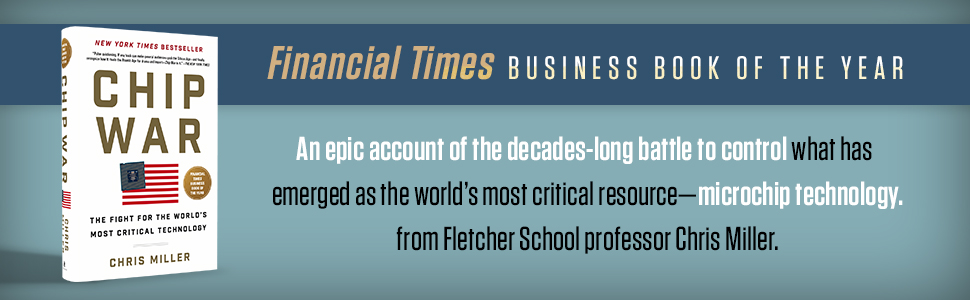
Chip War: The Fight for the World's Most Critical Technology [Miller, Chris] on desertcart.com. *FREE* shipping on qualifying offers. Chip War: The Fight for the World's Most Critical Technology Review: Extremely well timed overview of the history of semiconductor manufacturing - Chip War is a well timed history of semiconductor manufacturing and the intellectual currents that drove offshoring as well as bring concern over national security. The book is both historically informative as well as currently illuminating for thinking about the current US - China frictions on semiconductor manufacturing. One can learn about the pioneers of the industry and the history of government involvement as well as the cycles of intellectual property concerns. Chip War is both highly relevant for better understanding today's world of widening geopolitical fault lines as well as contextualizing how similar and or different things are today vs the past. The book starts out something along the lines of Walter Isaacson's Innovators giving the history of silicon valley and the discovery of transistor by Bardeen and Brattain, and then Shockley. The key characters who built up Silicon Valley and the entrepreneurial spirit that they embodied is highlighted so that one gets a sense of the early days in the valley. The competitiveness but also fluidity of the system led to significant innovation in the early days and the author gives a picture of the ecosystem. The first construction of the integrated circuit is discussed and the early development of logic chips is highlighted. The author is quick to highlight that copying technology is no route to success as its not technical knowledge but process expertise which is critical, understanding how to scale the business and increase yields is the key to consumer businesses which are critical for true scale. The Soviet Union attempted to catch up on semi-conductors via espionage which was a strategy destined for failure and the author gives the strong reminder that innovation is what drives the business not replication. At the early stages of the tech revolution the US dominated but was insulated from competition. The author moves on to the world as the conditions changed and Japan caught up. At first it was licensing technology on lower end goods but with Sony and others the tech gap narrowed and it looked like Japan was on the track to outpace the US. The US appeared to be lagging a more disciplined competitor with subsidized capital that was more cost competitive. Thus the reader gets a reminder that tech competition is not new and there is a strong reminiscence today of the competition with Japan in the 80s. Ultimately the concerns about Japan were overblown and eventually the US regained its intellectual lead where its competitive edge was strongest but with the exception of Micron, tech hardware manufacturing was slowly moving offshore. The author then moved on to the origins of TSMC and a little bit on Samsung. In particular for TSMC one learns that Morris Chang, founder of TSMC was a TI executive and not actually Taiwanese. Nonetheless the story of the rise of Taiwan in the tech supply chain is discussed and the relevance of the ambiguity with regards to China completely overlooked. The era of offshoring was the era of globalization where cost efficiencies were what determined capex decisions and the US government was not in the business of subsidizing capital despite the rest of Asia fully embracing that. The author moves on to China and the growth of a new kind of competitor. This competition was not as concerning until the last decade. Huawei is discussed as is the IP theft from Micron and the challenges of moving up the curve is highlighted with the lack of progress by SMIC. Chip Wars does a good job of bringing in the need of cutting edge processes for military dominance and the greater frictions that are arising due to these security concerns with China that were absent with prior competitions. The disregard of intellectual property is also highlighted through the Micron fiasco where Chinese courts used their system to blackmail Micron, though this backfired. Finally the author moves on to EUV and the astronomical complexity of the manufacturing process. The true complexity is used to show the fundamental challenge of trying to fast track your way to the cutting edge of tech hardware manufacturing. It is also used to highlight the truly global collaborative environment that was embraced to develop the technology and that same environment also led to offshore from the US without a concern. We are now in a new era where supply chain stability is being reconsidered as more important than supply chain cost. For technology this has big repercussions. On the margin we can certainly see the reverberations with the chip equipment export constraints and it is likely that these are used on a continued basis to manage competition in a fundamentally different way than in the past. To understand the history so that one can better appreciate the context, Chip War is a must read. Review: Haven’t read a more important book in a long time - I can still remember being very young and listening with my father to his vacuum tube radio. My memory of those glowing tubes is somewhat faint though because that tube radio soon got replaced by something a lot smaller. The age of the transistor radio had arrived. At that point in time, sometime in the 60s, no one could have imagined how the world was going to be impacted by transistors and integrated circuits etched on silicon wafers. In this book, Chris Miller traces the evolution of the semiconductor chip. It’s a journey that tracks technological innovation from the very beginning when physicists worked out how to create transistors on silicon to the age of modern day chips with billions of transistors crammed into tiny chips by manufacturing processes that are insanely complex. Parallel with the mind boggling tech innovation, Miller also records the vitally important history of the geopolitical ramifications of the semiconductor industry. We learn how important chips are in modern warfare. Taiwan’s critical role within the semiconductor global supply chain and the very small number of other important players are crucial factors as we think about how tech and geopolitical rivalries evolve. While the U.S. had the early lead and still leads by many measures, China is quickly catching up. We are told that China is not making the same mistakes that the Soviet Union made when they sought to keep pace with the U.S. in chip technology. Semiconductors are deeply enmeshed in the U.S.-China power struggle. Reading this book, one gets the impression that China’s efforts to create an advanced domestic chip industry may yet surprise the world. One is left wondering if China will perhaps deliver a “DeepSeek Moment” in the realm of semiconductor technology. For anyone curious about the future and interested in technological innovation and geopolitics, this book tells a truly important story in an interesting and even exciting way. From start to finish it is packed with information that you will want to know about.

| Best Sellers Rank | #29,798 in Books ( See Top 100 in Books ) #4 in International Economics (Books) #5 in National & International Security (Books) #62 in Economic History (Books) |
| Customer Reviews | 4.7 out of 5 stars 9,454 Reviews |
A**N
Extremely well timed overview of the history of semiconductor manufacturing
Chip War is a well timed history of semiconductor manufacturing and the intellectual currents that drove offshoring as well as bring concern over national security. The book is both historically informative as well as currently illuminating for thinking about the current US - China frictions on semiconductor manufacturing. One can learn about the pioneers of the industry and the history of government involvement as well as the cycles of intellectual property concerns. Chip War is both highly relevant for better understanding today's world of widening geopolitical fault lines as well as contextualizing how similar and or different things are today vs the past. The book starts out something along the lines of Walter Isaacson's Innovators giving the history of silicon valley and the discovery of transistor by Bardeen and Brattain, and then Shockley. The key characters who built up Silicon Valley and the entrepreneurial spirit that they embodied is highlighted so that one gets a sense of the early days in the valley. The competitiveness but also fluidity of the system led to significant innovation in the early days and the author gives a picture of the ecosystem. The first construction of the integrated circuit is discussed and the early development of logic chips is highlighted. The author is quick to highlight that copying technology is no route to success as its not technical knowledge but process expertise which is critical, understanding how to scale the business and increase yields is the key to consumer businesses which are critical for true scale. The Soviet Union attempted to catch up on semi-conductors via espionage which was a strategy destined for failure and the author gives the strong reminder that innovation is what drives the business not replication. At the early stages of the tech revolution the US dominated but was insulated from competition. The author moves on to the world as the conditions changed and Japan caught up. At first it was licensing technology on lower end goods but with Sony and others the tech gap narrowed and it looked like Japan was on the track to outpace the US. The US appeared to be lagging a more disciplined competitor with subsidized capital that was more cost competitive. Thus the reader gets a reminder that tech competition is not new and there is a strong reminiscence today of the competition with Japan in the 80s. Ultimately the concerns about Japan were overblown and eventually the US regained its intellectual lead where its competitive edge was strongest but with the exception of Micron, tech hardware manufacturing was slowly moving offshore. The author then moved on to the origins of TSMC and a little bit on Samsung. In particular for TSMC one learns that Morris Chang, founder of TSMC was a TI executive and not actually Taiwanese. Nonetheless the story of the rise of Taiwan in the tech supply chain is discussed and the relevance of the ambiguity with regards to China completely overlooked. The era of offshoring was the era of globalization where cost efficiencies were what determined capex decisions and the US government was not in the business of subsidizing capital despite the rest of Asia fully embracing that. The author moves on to China and the growth of a new kind of competitor. This competition was not as concerning until the last decade. Huawei is discussed as is the IP theft from Micron and the challenges of moving up the curve is highlighted with the lack of progress by SMIC. Chip Wars does a good job of bringing in the need of cutting edge processes for military dominance and the greater frictions that are arising due to these security concerns with China that were absent with prior competitions. The disregard of intellectual property is also highlighted through the Micron fiasco where Chinese courts used their system to blackmail Micron, though this backfired. Finally the author moves on to EUV and the astronomical complexity of the manufacturing process. The true complexity is used to show the fundamental challenge of trying to fast track your way to the cutting edge of tech hardware manufacturing. It is also used to highlight the truly global collaborative environment that was embraced to develop the technology and that same environment also led to offshore from the US without a concern. We are now in a new era where supply chain stability is being reconsidered as more important than supply chain cost. For technology this has big repercussions. On the margin we can certainly see the reverberations with the chip equipment export constraints and it is likely that these are used on a continued basis to manage competition in a fundamentally different way than in the past. To understand the history so that one can better appreciate the context, Chip War is a must read.
C**K
Haven’t read a more important book in a long time
I can still remember being very young and listening with my father to his vacuum tube radio. My memory of those glowing tubes is somewhat faint though because that tube radio soon got replaced by something a lot smaller. The age of the transistor radio had arrived. At that point in time, sometime in the 60s, no one could have imagined how the world was going to be impacted by transistors and integrated circuits etched on silicon wafers. In this book, Chris Miller traces the evolution of the semiconductor chip. It’s a journey that tracks technological innovation from the very beginning when physicists worked out how to create transistors on silicon to the age of modern day chips with billions of transistors crammed into tiny chips by manufacturing processes that are insanely complex. Parallel with the mind boggling tech innovation, Miller also records the vitally important history of the geopolitical ramifications of the semiconductor industry. We learn how important chips are in modern warfare. Taiwan’s critical role within the semiconductor global supply chain and the very small number of other important players are crucial factors as we think about how tech and geopolitical rivalries evolve. While the U.S. had the early lead and still leads by many measures, China is quickly catching up. We are told that China is not making the same mistakes that the Soviet Union made when they sought to keep pace with the U.S. in chip technology. Semiconductors are deeply enmeshed in the U.S.-China power struggle. Reading this book, one gets the impression that China’s efforts to create an advanced domestic chip industry may yet surprise the world. One is left wondering if China will perhaps deliver a “DeepSeek Moment” in the realm of semiconductor technology. For anyone curious about the future and interested in technological innovation and geopolitics, this book tells a truly important story in an interesting and even exciting way. From start to finish it is packed with information that you will want to know about.
F**8
Good reference book
Well researched book that follows the Chips industry from its early infancy until 2022. As the sector is still evolving rapidly, this book is already a bit outdated and better used for historical references. Despite his best efforts to stay objective, the author invariably portrays the US as always "reasonable" while other countries are either "cheating" or "dangerous". For example, while many US chip companies are "heroically" helping US military to create deadly weapons, any Chinese tech company with any military association should be blacklisted. The author also annoyingly mentions "Gordon Moore" and "Caltech professor Carver Mead" together, many times, ignoring the fact that Moore himself is a Caltech PhD.
C**N
Informative
Excellent, well written ,informative book.
C**E
Loved This Book
I don't usually enjoy reading books of this nature, but I went for it anyway. The author did a great job telling the "chip war" story and I loved it. He knows what he's writing about and uses common, relatable, and non-pretentious language. I have a much deeper knowledge of the topic and am looking forward to his next book.
F**G
A story of innovation history and Chinese competition
I have the hardback, which is 431 pages including acknowledgments, extensive notes and index. There are 351 pages of text itself. The book is well-written and a relatively easy and informative read for which the author deserves credit. There are some good reviews of the book that outline the history of the development of the chip and some of the seminal figures involved in its development. I live in Dallas close to the central Texas Instruments plant where Jack Kilby and Morris Chang, whose contributions to the creation of the chip industry are outlined, worked. In the very late 1980s, Texas Instruments was a member of a chamber of commerce with which I volunteered. TI invited us over for a presentation. During the presentation TI observed that they had developed systems that would allow the US to send a missile 800 miles and hit a target the size of a barrel. This claim was impressive and the gentleman sitting next to me leaned over and whispered in my ear "I'll bet the Russians have a bulls-eye drawn around this place." A few years later in the 1st Gulf War, TI's claim was verified. You don't have to persuade me that computer chips are a critical technology. I divide the book into the first roughly 2/3rds that looks at the history of the chip and the US role in its development. This role in fabrication and lithography was initially critical. But, as noted in the book, "America's technological lead in fabrication, lithography and other fields had dissipated because Washington convince itself the companies should compete but that governments should simply provide a level playing field." Pg. 298. Other governments, particularly China, did not share this view. The last roughly 1/3rd of the book, largely beginning in Section VII, looks at the Challenge of China. The history is interesting, but if you're mainly interested in the Chinese competition and the effects of globalization, you may want to start here and see what the author has to say. TSMC, located in Taiwan, manufactures a large percentage of the more sophisticated chips used globally. ASML, located in the Netherlands, manufactures basically all of the lithography equipment necessary to manufacture high-end chips. Korea and Japan manufacture meaningful amounts of the chips necessary for cars, phones, etc., but the loss of TSMC in, for instance, an attempt by China to take over Taiwan would have a huge impact on our daily lives. It's also not clear that the Netherlands intends to willingly relinquish its primacy in manufacturing essential lithography equipment. So, the book explores the effects of U.S. efforts to globalize the manufacture of chips. The U.S. has tried to maintain some primacy of the design of chips in Silicon Valley and the book looks at some of these efforts. Recently the U.S. government has recognized the shortcomings of globalization and is trying to bring chip manufacturing back to America. The author makes a compelling case that computer chips are a critical technology. The history of the development of this technology and U.S. competition with China are the focus of this book. If these topics are of interest to you, I recommend the book highly.
S**N
Great summary of the geopolitical power that derives from the advanced alchemy of computation
The early history of the semiconductor industry was the most interesting part to me. Chip Wars does not pull any punches when it comes to the failings of Russia, China and Intel. Here are the passages that caught my eye or packed the most punch: “Last year the chip industry produced more transistors than the combined quantity of all goods produced by all other companies, in all other industries, in all human history. Nothing else comes close.” (p.xxi) “Around a quarter of the chip industry’s revenue comes from phones. Today, Apple’s most advanced processors can only be produced by a single company in a single building, the most expensive factory in human history.” (p.xx) Chip History — U.S. vs. USSR “At the outset, the integrated circuit cost 50x as much to make as a simpler device made with separate components wired together. Everyone agreed Noyce’s invention was clever, even brilliant. All it needed was a market. Three days after Noyce and Moore founded Fairchild Semiconductor, the answer to the question of who would pay for integrated circuits hurtled over their heads: Sputnik, the world’s first satellite, launched by the Soviet Union. Boy Noyce suddenly had a market for his integrated circuits: rockets. The first big order for Noyce’s chips came from NASA.” (19) “By November 1962, Charles Stark Draper, the famed engineer who run the MIT Instrumentation Lab had decided to bet on Fairchild chips for the Apollo program. The computer that eventually took Apollo 11 to the moon weighed 70 pounds and took up about one cubic foot of space, a thousand times less than the ENIAC computer that had calculated artillery trajectories in World War II. MIT considers the Apollo guidance computer one of its proudest accomplishments.” (20) “NASA’s trust in integrated circuits to guide astronauts to the moon was an important stamp of approval.” (21) In 1963, “TI’s shipments to the Air Force accounted for 60% of all dollars spent buying chips to date. By the end of 1964, Texas Instruments had supplied 100,000 integrated circuits to the Minuteman missile program.” (22) “In 1965, military and space applications would use over 95% of the integrated circuits produced that year.” (29) “Moore’s Law was the greatest technological prediction of the century. Moore later argued that Noyce’s price cuts were as big an innovation as the technology inside the integrated circuits.” (31) “In 1966, Burroughs, a computer firm, ordered 20 million chips from Fairchild — more than 20x what the Apollo program consumed. By 1968, the computer industry was buying as many chips as the military.” (32) “Copying was literally hardwired into the Soviet semiconductor industry, with some chipmaking machinery using inches rather than centimeters to better replicate American designs, even though the rest of the USSR used the metric system. The Soviet ‘copy it’ strategy was fundamentally flawed, however. Copying worked in building nuclear weapons, because the U.S. and the USSR built only tens of thousands of nukes over the entire Cold War.” (43) They could not keep up with Moore’s Law. “In 1985, the CIA conducted a study of Soviet microprocessors and found that the USSR produced replicas of Intel and Motorola chips like clockwork. They were always a half decade behind.” (144) “The KGB began stealing semiconductor manufacturing equipment too. The system of theft and replication never worked well enough to convince Soviet military leaders that they had a steady supply of quality chips, so they minimized the use of electronics and computers in military systems.” (143) “Japan alone spent 8x as much on capital investment in microelectronics as the USSR.” (149) “The problem with many guided munitions, the military concluded, was the vacuum tubes. The Sparrow missile’s radar system broke on average once every 5 to 10 hours of use. A post war study found that only 9.2% of Sparrows fired in Vietnam hit their target, while 66% malfunctioned, and the rest simply missed.” (58) “Even the vacuum-tube-powered Sidewinder air-to-air missiles that missed most of their targets above Vietnam were upgraded with semiconductor-based guidance systems. They were 6x as accurate in the Persian Gulf War as in Vietnam.” (153) “A simple laser sensor and a couple transistors turned a weapon with a zero-for-638 hit ratio into a tool of precision destruction. Outside a small number of military theorists and engineers, hardly anyone realized Vietnam had been a successful testing ground for weapons that married microelectronics and explosives in ways that would revolutionize warfare and transform American military power.” (61) Like AI + drones in Ukraine today. “If the future of war became a contest for accuracy, the Soviets would fall behind. Guided missiles would not only offset the USSR’s quantitative advantage, they’d force the Soviets to undertake a ruinously expensive anti-missile effort in response.” (75) “Soviet estimates suggested that if the U.S. launched a nuclear first strike in the 1980’s, it could have disabled or destroyed 98% of Soviet ICBMs.” (147) “The Iraqi military — armed with some of the best equipment the Soviet Union’s defense industry produced — was helpless in the wake of the American assault. The reverberations of the smart bombs were felt as powerfully in Moscow as in Baghdad.” (154) “The Russian chip industry faced humiliation, with one fab reduced in the 1990s to producing tiny chips for McDonald’s Happy Meal toys. The Cold War was over; Silicon Valley had won.” (159) Japan “Sony’s research director, the famed physicist Makoto Kikuchi told an American journalist that Japan had fewer geniuses than America, a country with ‘outstanding elites.’ But America also had a ‘long tail’ of people ‘with less than normal intelligence,’ Kikuchi argued, explaining why Japan was better at mass manufacturing.” (83) “In 1985, Japanese firms spent 46% of the world’s capital expenditures on semiconductors, compared to America’s 35%.” (89) That was the year they ruined Mostek, the world’s largest memory chip fab at the time: “’We’re in a death spiral,’ Bob Noyce told a reporter in 1986. In the late 1980s, Intel’s equipment was running only 30% of the time due to maintenance and repairs” (106) In 1989, Shintaro Ishihara wrote: “Japan has nearly a 100% share of 1-megabit semiconductors. Japan is at least five years ahead of the United Stated and the gap is widening.” (112) China “Many of the best graduates from China’s universities before the revolution ended up working in Taiwan or in California. The year after China produced its first integrated circuit, Mao plunged the company into the Cultural Revolution, arguing that expertise was a source of privilege that undermined socialist equality.” (172) Sounds oddly familiar. “During the decade in which China had descended into revolutionary chaos, Intel had invented microprocessors, while Japan had grabbed a large share of the global DRAM market. China accomplished nothing beyond harassing its smartest citizens.” (174) “A study in 1979 found that China had hardly any commercially viable semiconductor production and only 1500 computers in the entire country.” (175) “U.S. fabs made 37% of the world’s chips in 1990, but this number fell to 19% by 2000 and 13% by 2010. South Korea, Singapore and Taiwan rapidly increased output.” (177) “No country has been more successful than China at harnessing the digital world for authoritarian purposes.” (244) “China has less than 1% of the global software tools market. China supplies 4% of the of the world’s silicon wafers and other chipmaking materials. It has only a 7% market share in the business of fabricating chips. None of this fabrication capacity involves high-value, leading-edge technology.” (249) “The future of war will be defined by computing power… a belief in the Chinese military circles that warfare is being ‘intelligentized’ — inelegant military jargon that means applying AI to weapons systems.” (284) “29% of the world’s leading researchers in AI are from China, as opposed to 20% from the U.S. and 18% from Europe. However, a staggering share of these experts end up working in the U.S., which employs 59% of the world’s top AI researchers.” (286) “China is still staggeringly dependent on foreign semiconductor technology — in particular, U.S.-designed, Taiwan-fabricated processors — to undertake complex computation. 95% of GPUs in Chinese servers running AI workloads are designed by NVIDIA.” (286) “The U.S. military will only succeed if it has a decisive technological advantage. The 1970s offset was driven by digital microprocessors, IT, sensors, stealth. This time it will be advances in AI and autonomy.” (287) “Obama’s China team concluded ‘that everything we’re competing on in the 21st Century, all of it rests on the cornerstone of semiconductor mastery.” (300) “Escalating tech competition with the United States is like a Sputnik moment for China’s government.” (320) “Establishing a cutting-edge, all-domestic supply chain would take over a decade and cost well over a trillion dollars in that period. This is why, despite the rhetoric, China’s not actually pursuing an all-domestic supply chain. Beijing recognizes this is simply impossible.” (323) “China now spends more money each year importing chips than it spends on oil.” (p.xviii) Taiwan “TSMC’s Fab 18 fabricated well over 1 quintillion transistors.” (p.xxi) “Taiwan fabricates 37% of the world’s logic chips. After a disaster in Taiwan, the total costs would be measured in the trillions. It would take at least half a decade to rebuild the lost chipmaking capacity.” (341) Lithography “ASML builds 100% of the world’s extreme ultraviolet lithography machines, without which cutting edge chips are simply impossible to make. OPEC’s 40% share of world oil production looks unimpressive by comparison.” (p.xxv) In 1986, the U.S. pioneer “GCA lost its position as the only company building steppers. Japan’s Nikon had initially been a partner of GCA, providing the precision lenses for its stepper. It acquired a machine from GCA and reverse engineered it. Soon Nikon had more market share than GCA.” (94) “GCA struggled with mass production. Precision manufacturing was essential, since lithography was now so exact that a thunderstorm rolling through could change air pressure — and thus the angle at which light refracted — enough to distort the images carved on chips.” (94) “By the end of the 1980s, Japan was supplying 70% of the world’s lithography equipment. America’s share had fallen to 21%.” (99) “Intel would eventually spend billions of dollars on R&D and billions more learning how to use EUV to carve chips. It never planned to make its own EUV equipment” (184) “The manufacturing of EUV wasn’t globalized, it was monopolized. A single supply chain managed by a single company [ASML] would control the future of lithography.” (189) “EUV was one of the biggest technological gambles of our time. Intel alone invested $4B in ASML in 2012, an investment that followed billions of dollars of previous grants and investments Intel had spent on EUV, dating back to the era of Andy Grove.” (225) “Producing enough EUV light requires pulverizing a small ball of tin with a laser. The tin is struck twice with a laser. The first pulse is to warm it up, the second is to blast it into a plasma with a temperature around a half million degrees, many times hotter than the surface of the sun. This process is then repeated 50,000 times per second to produce EUV light in the quantities necessary to fabricate chips.” (226) The laser needed ultrapure diamond windows, multi-layer mirrors that are smoother than any other object manufactured, and each machine had 457,329 parts and cost over $100M each. Their new high-aperture EUV machine costs $300M each. “ASML’s EUV lithography tool is the most expensive mass-produced machine tool in history, so complex it’s impossible to use without extensive training from ASML personnel, who remain on-site for the tool’s entire life span.” (230) “Chapter 41: How Intel Forgot Innovation. The company spent over $10 billion a year on R&D throughout the 2010s, four times as much as TSMC. Only a couple companies in the world spent more. Intel has now spent half a decade announcing ‘temporary’ manufacturing delays. Most people in the industry think many of the company’s problems stem from Intel’s delayed adoption of EUV tools. By 2020, half of all EUV lithography tools, funded and nurtured by Intel, were installed at TSMC. By contrast, Intel had only barely begun to use EUV in its manufacturing process.” (240)
J**E
Good Book
Good book got it for less than 5 dollars
Trustpilot
2 weeks ago
2 days ago