
DOWNLOAD THE APP



Desert Online General Trading LLC
Warehouse # 7, 4th Street, Umm Ramool, Dubai, 30183, Dubai
DOWNLOAD THE APP
Desert Online General Trading LLC
Warehouse # 7, 4th Street, Umm Ramool, Dubai, 30183, Dubai
Full description not available
D**T
Extremely comprehensive, informative, and entertaining
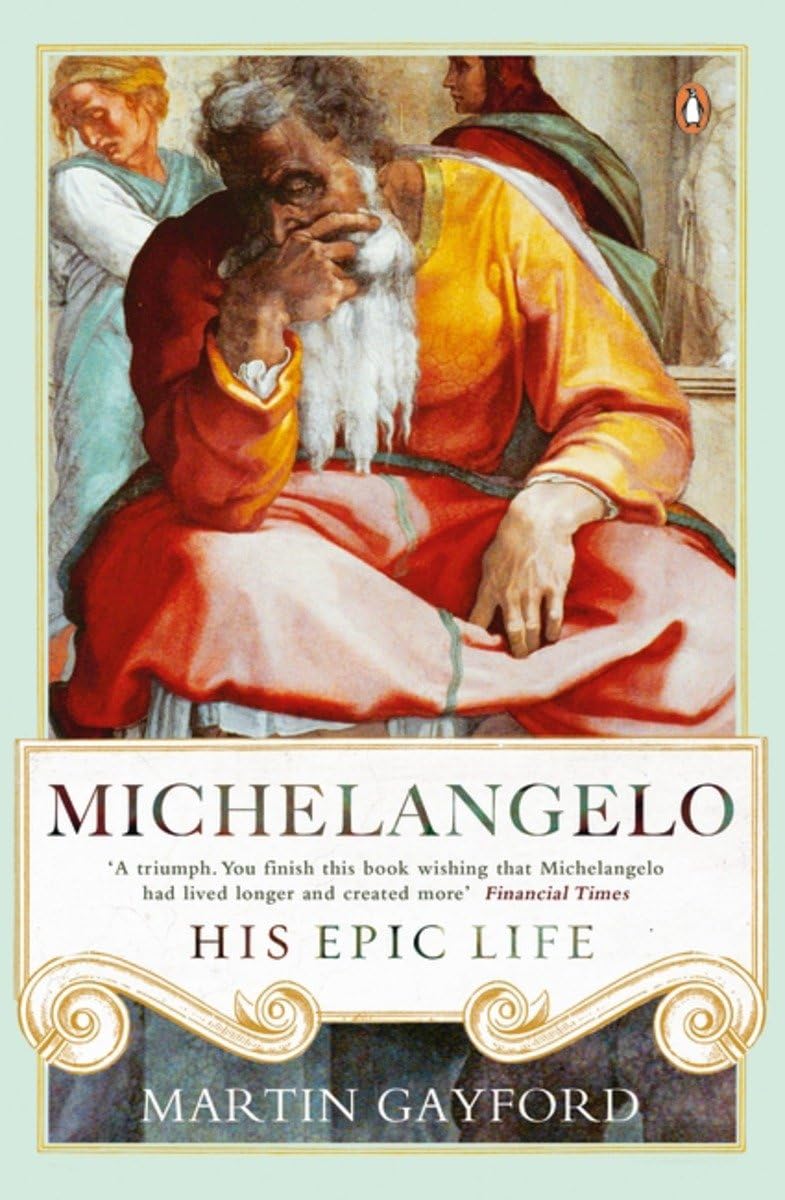
“The day that Michelangelo walked into Lorenzo’s sculpture garden at San Marco changed his life, and hence the course of Western art.” I got this in preparation for the Michelangelo exhibition at my local art museum. This book was super interesting, and even thrilling, especially for a subject that most would probably imagine to be pretty dry. Michelangelo can only be described as one crazy and wild dude, which probably also explains a lot of his brilliance. For instance, about 500 years ago, a 25 year old Michelangelo was putting the finishing touches on his Pieta, possibly the most priceless piece of artwork on the whole planet. As he was doing so, his father wrote him a testy letter basically telling him he was worthless, stating there is “no one to give me the slightest help or provide for me, not even with a glass of water.” This isn’t even the best story about the Pieta, though. Once he conceived of the statue (and obtained the requisite commission), Michelangelo knew it was going to make his career. He even personally travelled to Carrara to select the piece of marble to be quarried himself. Of course, when he finished, the work was a total masterpiece. However, as with his father, to the general public Michelangelo’s genius was yet unknown. After the statue was put on display at the Vatican, he overheard someone in the stupefied crowd saying that a sculptor from Milan had created it. Disgusted, the young artist climbed up on the statue and chiseled “Michelangelo made this” across Mary’s chest. To this day, you can see these vainglorious words, albeit now from behind bulletproof glass. This was also the last piece of art Michelangelo ever signed, as from then on, it was evident to all who had made the work in question. Additionally, the ceiling of the Sistine Chapel had a rather bizarre, if not entertaining genesis (see what I did there?). Following the Pieta, Michelangelo was promised that he could sculpt the Pope’s tomb (an enormous feat that called for 30 some statues). However, the Pope pulled a switcheroo and told Michelangelo he had to paint the ceiling of the chapel instead. Despite being quite adept at it, Michelangelo did not really care for painting, to say the least. So, doing what any reasonable person would, he defied the Pope in a fury, grabbed a horse, fled Rome, and rode 24 hours straight toward Florence. Now equally enraged, the Pope dispatched five soldiers after Michelangelo with instructions to haul the artist back; however, by the time the soldiers caught up to him, they had crossed out of the Papal States and into Tuscany. Michelangelo then calmly told the soldiers that if any of them attempted to touch him he would have them all murdered. The soldiers discussed this at length, and in the end decided that they didn’t know whether this threat was actually within Michelangelo’s power or not. Instead, they simply tried to convince him to come back. When he still refused, they just begged him to write a letter to the Pope explaining they had tried their best. Michelangelo aloofly told them to tell the Pope that he would never set foot in Rome again (this was a whopper, if there ever was one). Finally, it fell to the leader of Florence himself to try and get Michelangelo to return to Rome, writing him “you’ve tried and tested the Pope as not even the King of France would dare, so he will no longer wait to be asked.” This entreaty from the ruler of his native-city, as we now know by one of the great works of art in the world, was ultimately successful. Not everything from there was smooth sailing, though. One day, the Pope presumed to ask Michelangelo when he would be done with the chapel. Michelangelo tartly replied “when I’m able to.” To this impudence, the Pope angrily responded “you want me to have you thrown off that scaffolding, don’t you?” Somehow, this last part doesn’t seem very Christian, from the heir of Saint Peter, no less. Then, after completing one of the most famous paintings ever, Michelangelo was clearly disappointed with the result, writing “things have not turned out for me as I’d hoped; for this I blame the times, which are very unfavorable to our art.” Others weren’t so thrilled with the painting either. The following Pope intended to have the frescoes on the ceiling of the chapel removed entirely, calling them “a bath house of nudes.” Luckily for us, this Pope died before he could carry this project out. In any case, Michelangelo often continued to defy and speak to the Pope as he pleased. At one point, unhappy with the price of a marble purchase, he wrote him “if the Pope is issuing Bulls granting license to rob, I beg your Most Reverend Lordship to get one issued to me too, because I have more need of it than they.” In another instance, when trying to get Michelangelo back to work while he was in a tiff, an official at the Vatican wrote to the artist “the Pope values you, he shows that he knows you and loves you, but you frighten everyone, including popes.” This was in response to the Pope saying “he is terrible; one cannot deal with him.” If all this sounds rather presumptuous, consider the following excerpt from a letter Michelangelo wrote: “even his Holiness annoys and wearies me when at times he talks to me and asks me somewhat roughly why I do not come to see him...I told him I was better occupied working for the Pope in my own house instead of by standing before him all day, as others do.” Michelangelo’s high opinion of himself can perhaps best be seen in his design for St. Peter’s Basilica. Despite it being the largest church in the world, he actually shrunk the original layout, and to accomplish this had much of the earlier, and extremely expensive work torn down. In doing so, he invented baroque architecture (all the while continually stating that architecture, or even painting “was not my profession”). Anyways, its not totally surprising that he held this negative view of his work. When he was a child, his father and uncle used to take turns beating him mercilessly any time they caught him drawing or painting (they wanted him to become a merchant). Once the family relented, however, Michelangelo was taken into the Medici household to foster his talent. This was one of the the most fascinating parts of the book. The Medici had collected all of Italy’s greatest artists, musicians, and writers under one roof, and kept them in residence in their massive villa. In addition, because the Medici were not technically royalty, their household was much more relaxed than most rulers. This meant that every evening these luminaries surrounded Lorenzo “the Magnificent” de Medici at the supper table where they could converse and exchange ideas. One ambassador even complained about this informality, and was told with the Medici, the more you are treated like family, the greater the honor. I was also surprised to learn that Michelangelo was more or less openly gay during his lifetime. Apparently, this wasn’t all that big of a deal in Renaissance Florence. Technically, the penalty was being burned at the stake. However, in practice, the law wasn’t enforced at all, and when it was, there was merely a fine levied. Even in death, Michelangelo was quite the character. When he died, they found an equivalent amount of gold stuffed under his bed that the Medici had recently paid for the entire Pitti Palace. The Pope and the Medici also got in a fight over in which city Michelangelo’s body would be interred. Ultimately, his corpse ended up being smuggled out of Rome in a bale of hay (eat your heart out Saint Mark) by Florentine agents, so it could be placed in a tomb at Santa Croce (at one point, the body spilled out of its concealment where it landed in a heap on the church floor). This book was equal parts compelling and informative; although, I’m not sure how engaging it would be to someone who didn’t have a preexisting interest in the subject. I think you would also need to have at least a basic idea of Italian and Florentine history to totally follow it. I’m not super familiar with art history or terms, and so struggled with this aspect of the text a bit (and ended up looking a lot of things up). This book was also really long and really dense. Still, it is one of those texts where you walk away from it feeling like you have truly gotten to know the person featured.
D**N
Masterpiece ❤️
I would give this book more than 5 stars if I could. The author, Martin Gayford, produced a masterpiece of his own. One of the best. So informative and intimate. I literally felt like I was walking side-by-side Michelangelo through his entire 88 years on the planet from childhood to death. The details behind the paintings, sculptures, and architecture productions were compelling. And not to mention his personality quirks, day to day life, travels, food, meetings with the Pope and other high ranking officials of the day commissioning pieces, family dynamics, illnesses and treatments, and beyond. I talked about this book for months like I had a personal relationship with Michelangelo and understood the struggles of getting a slab of marble out of a mountain (lol). Greatly appreciated Gayford including so many photos and stating where the art is located. Read this book it will not disappoint.
V**E
SUPERB "LIFE OF" STORY of the greatest painter that ever lived.
Superb Book, fabulous information and photographs. You will most certainly not have learned these facts in school! If you want to know just about everything that can be known, this is a great book to spend some time with. The story is as good as the art. One must always remember while reading, that the time and place this artist grew up and lived in... be prepared to transcend the urge to compare with modern artists, or see the story and art through modern eyes. All the fabulous artists from this time period were so very different, life was different... the art certainly blossomed because of that, we have nothing like it today.
Z**T
Epic work for an epic man
lovely, lovely piece of work. Gayford really has a way of transplanting you to the 15th and 16th Centuries before placing you almost square in the great man's shoes.You marvel along with Lorenzo de Medici at the early signs of genius, you feel his intensely reclusive and inscrutable nature so deeply you feel at one with him. You sympathize with his struggles with his piety and sexuality. You grow almost parallel to him and will be moved by his genius for lack of a better word.really it doesnt even come close to what he achieved. his pieta and Moses are awe inspiring, humbling,healing, and his frescoes are just brilliant.Martin calls the pieta almost hallucinatory in its presence and its power is almost overwhelming really. and I am not even a religious person.Tip: enjoy this book slowly, its one to savored rather than devoured.what a towering piece.
A**R
Brilliant biography of the genius
Gayford's is a highly enjoyable, thoroughly researched and empathetic work on the life of (to me) the greatest visual artist of them all. Michelangelo is a very colorful subject, who he lived a long, eventful life in a key age. Also, the edition is beautiful, lavishly illustrated with the works that are being discussed at that point (not all together at the center of the book). I've enjoyed it much more that Issacson's book on Leonardo. This book should have many more reviews than it has.
C**E
A well researched, well written classic.
Martin Gayford is an excellent writer, who captures well the character and times of Michelangelo. Like all of Gayford's books - the physical quality of the book itself is fine. The paper is thick, the print is clear and easily readable and the illustrations (of which there are many) are of high quality. A long book - 563 pages of text plus notes - it draws the reader into the creative life and mindset of the artist. Highly recommended.
T**E
A very scholarly read
If you are intrigued by the life and works of Michael Angelo include this book in your quest to learn. Gayford's research efforts are delivered to the reader in an academic yet personal style. He will take you to 16th century Italy and introduce you to Michael Angelo. A complex and very human artistic genius. I look forward to reading this book again with a notebook next to me. Enjoy this like you enjoyed your freshman European History class!
A**R
Brilliant
All Martin Gayford's books are brilliant. The writer is very talented. The story of Michelangelo's life is told in a captivating manner. The style of writing makes this book accessible and fascinating.The only drawback is the weight of this book. It could have been published in two volumes if the publisher employed anybody with some brain. Some of us like to read books in print and we don't buy them to use them as door stops. How difficult is it to figure that out if you are in publishing?
S**S
Brilliant x
Brilliant book, heavy to hold, but worth the workout !
H**Y
This is a wonderful biography. It is vivid and enthralling and will ...
This is a wonderful biography. It is vivid and enthralling and will appeal to a wide range of readers. I finished reading it a week ago and cannot stop thinking about it. I cannot wait to get back to Florence and to Rome!
L**N
An untraditional biography with a reach historical background
The Gayford's book isn't a tipical biography. Full of a lot of historical events and more information, I was surprised in the end. I expected more from Michelangelo's life, for example his life outside of art, feelings. Fragments are presented.
T**D
Impressive
Very impressive and informative
Trustpilot
2 months ago
1 day ago