
DOWNLOAD THE APP


Customer Services
Copyright © 2025 Desertcart Holdings Limited
DOWNLOAD THE APP
![Blue Planet II [DVD] [2017]](https://m.media-amazon.com/images/I/41AI9GUazkL.jpg)
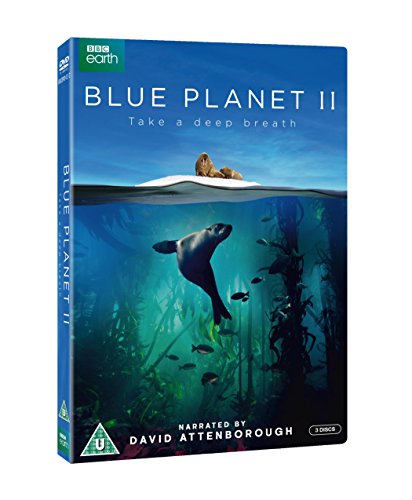
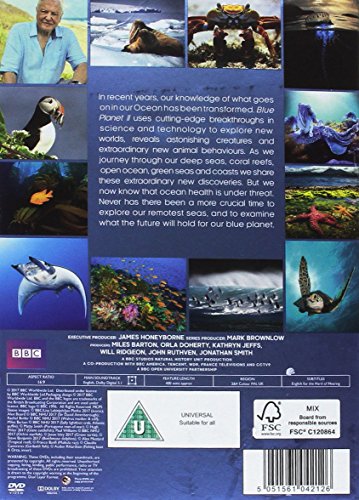


This bold cinematic experience takes viewers on a magical adventure across the greatest, yet least known parts of our planet – our oceans.Since The Blue Planet aired in 2001, our understanding of life beneath the waves has completely changed. Travelling from the icy polar seas to the vibrant blues of the coral atolls, Blue Planet II shares these astonishing new discoveries.In recent years, our knowledge of the natural world and what goes on in our Ocean has been transformed by each stunning wildlife documentary from David Attenborough. Blue Planet II uses cutting-edge breakthroughs in science and technology to explore new worlds, reveals astonishing creatures and extraordinary new animal behaviours. As we journey through our deep seas, coral reefs, open ocean, green seas and coasts we share these extraordinary new discoveries. But we now know that ocean health is under threat. Never has there been a more crucial time to explore our remotest seas, and to examine what the future will hold for our blue planet.Narrated by David AttenboroughEpisodes:Episode 1 - One OceanEpisode 2 - The DeepEpisode 3 - Coral ReefsEpisode 4 - Big BlueEpisode 5 - Green SeasEpisode 6 - CoastsEpisode 7 - Our Blue PlanetBlue Planet II Diaries can be found on the Blu-ray Discs, these were filmed in HD only.✔ ULTRA HD BLU-RAY WITH HDR FEATURES:✔ RESOLUTION - FOUR TIMES SHARPER THAN HD✔ HDR (HIGH DYNAMIC RANGE) BRILLIANT BRIGHTS, DEEPEST DARKS✔ COLOUR - WIDER COLOUR SPECTRUM Review: Full immersion - One of the most ambitious nature series ever undertaken, and it shows. Over four years in the making, the world’s five oceans explored, the most sophisticated hi-tech photography equipment used, thousands of man-hours and millions of pounds invested in 125 expeditions and 4,000 dives. Along with this, the beautiful haunting music of Hans Zimmer and Radiohead in collaboration, as well as the wise, elegiac voice of Sir David Attenborough who speaks in near-lament at what we are doing to the oceans with our plastic junk, carbon effluence and industrial-scale overfishing. If anything, the world’s beautiful coral reefs act as a marker of the health of our planet and civilisation. If they go, if we manage to kill them off with rising ocean temperatures and polluted, acidic seas, maybe they constitute the suicide note we are unconsciously writing to the world. This is the tone of the programme: so much beauty and variety, so much knowledge and intelligence, yet between them so much fragility and thoughtless destruction. It’s as if Sir David is beseeching us to grow up and become mature and responsible adults, leaving our reckless teen years behind. Here is a vivid portrait of all the underwater beauty and diversity we stand to lose if we do not change our way of thinking and living. But apart from morality tale, it’s also a great education, punctuated by simple facts and stats. For instance, the landmass of Earth makes up only 30% of our planet’s surface. 97% of all water on Earth is contained in the oceans. The world’s greatest wilderness — the open ocean or Big Blue — covers 50% of Earth’s surface, the marine equivalent of a desert. In it, Sir David says, there’s nowhere to hide and little to eat. 90% of all fish live in the so-called twilight zone where light from the sun begins to fade at a depth of 200 metres. This zone extends to a depth of 1,000 metres, thereafter called the midnight zone, which is pitch black. How do animals navigate there in the dark? With their own lights, which are wild, weird, spooky, and colourful like flashing disco and strobe lights. Dancing at the bottom of the oceans? Of course. Didn’t you know God has a sense of humour? Other facts and assertions. We know more about the surface of Mars than we do about the geology, chemistry and biology of our ocean floors. The chemicals of life were first mixed in the hothouse kitchen at the centre of our planet then released through thermal vents into the oceans. Life most likely began at the interface of these ocean vents and Earth’s interior. One day our technology may allow us to confirm this, as we know some of the moons of Jupiter (Ganymede and Callisto) and Saturn (Titan and Mimas) have oceans as well, and we also know the laws of physics are universal, equal, unequivocal. Why should life only exist on Earth? In all probability it does not. Our home, our planet, is special and precious, but that doesn’t mean it’s unique. This should cheer us. At least it cheers me. A few spoiler examples of extraordinary animal behaviour in the oceans of Earth follow, so please stop reading if you’d rather not know (though it’s just a sampler list with many other examples omitted). • Dolphins in South Africa ride and surf the crests of huge waves for the sheer joy, pleasure and fun of it. No kidding! • Other dolphins and whales congregate and communicate in order to coordinate large underwater hunting pacts and packs. • A fish in Australia has worked out the dynamics of cause and effect, clearly seeing into the future through its logic. He smashes the sturdy shells of clams against hard rock or coral to get at the soft, juicy, tasty bits inside. He is clumsy but persistent, keeping his eyes on the prize. Like us and chimpanzees, he is a toolmaker. • Another fish of the oceanic deep lives in the midnight zone. His skull is clear and luminescent. You can see right through it and so can he. Why? Better to spot prey (and predators) above him without turning over to look. Easier just to peer right up through your skull to examine the world. Given enough time to tinker and experiment, evolution by natural selection always arrives at ingenious ways in which to survive and thrive. There are seven episodes in the series, each an hour in length: One Ocean The Deep Coral Reefs Big Blue Green Seas Coasts Our Blue Planet The final episode (Our Blue Planet) is the most sobering, as it details what is happening to the planet and its oceans and what must be done to limit or halt the destruction. Less than 1% of our international waters are protected, and as Sir David says: “The creation of marine reserves is vital if we’re to safeguard the future of many ocean creatures.” In the last three years over two-thirds of the world’s coral reefs are thought to have suffered from rises in ocean temperatures. Carbon dioxide from the atmosphere dissolved in seawater forms carbonic acid which destroys the calcium carbonate shells of sea creatures as well as coral reefs. Our cars, jet aircraft and especially our factories dump millions of tonnes of CO2 into the atmosphere as if the planet had an infinite capacity to absorb this noxious chemical compound. Homo sapiens sits in the dock of some celestial courtroom in my imagination, guilty as charged for ruining his planet. The judge shows no mercy, the prisoner dragged away in chains to serve out his sentence with extreme finality, that sentence being extinction. But not all is lost, including hope. As more knowledge accumulates, the better we understand and are better equipped to logistically take well-informed, intelligent action. The final episode highlights local success stories around the globe and the work of dedicated people in educating others to make a difference. If one thinks this is pie in the sky, then they are just not trying or caring enough to want to try. It all begins at home with the choices you make in daily life: recycling, bicycling instead of driving, less flying, less needless consumption, no plastic shopping bags. This is true whether many in the world want to believe it or not. You are responsible for your own carbon footprint. I have never before seen underwater photography as clear, vivid, colourful and beautiful as this. I should probably re-watch the entire series in the bath for full immersion sensation. As it is, even on the settee, I feel as though I am snorkelling above coral reefs. Wondrous experience. I shouldn’t be able to imagine anyone disparaging this series, though there will always be nitpicking malcontents impossible to please. Thankfully, these form a slender minority here. The series currently has an 83% 5-star rating at desertcart.co.uk, and my review may push it closer to 84%. I’m thankful Sir David is still living (now aged 91) and working. No retirement for some! Thankful too for the professionalism and commitment of the BBC in commissioning the series. When I saw Blue Planet over ten years ago I thought to myself: “That’s it. They’ve gone all out. This series can’t be bettered.” But I was wrong. Very wrong. The current series is even greater. I would even say greater by far. The technological development in underwater photographic technology over the past dozen years has been truly phenomenal. The clarity of the images, even at 11,000 metres deep in the Mariana Trench (the deepest gash in the surface of the earth), is astonishing. If I didn’t know better, I would think I was looking at CGI — but we are not in this series. A dozen years ago I was in the Cook Islands and French Polynesia, visiting Tahiti, Mo’orea and Bora Bora, among other beautiful islands and atolls. What I saw snorkelling and scuba diving underwater there with my own eyes I now see reproduced here almost perfectly. I was joking about the bath, but maybe it’s not such a bad idea (even if it is). Imagine that — getting electrocuted by the BBC! Anyway, full immersion with this series. You will not see better underwater photography anywhere else anytime soon. Bravo to Sir David and the BBC. And love the earth, the only home you’ll ever have! Review: A "must have" for anyone who is interested in nature, and who likes Attenborough! - Have just finished watching this, and believe me, the quality of this is excellent. Attenborough is superb as a commentator, and we get to see things that have never been able to be filmed before, due to a specialised underwater submarine camera. We learn new interesting facts, film the corals, go down to the bottom of the ocean film whales, tuna, and lantern fish. It makes it look easy, but we learn how hard it was for the film crew to film the scenes they wanted to film. In one case, they missed a scene by 24 hours, and had to wait another year, before they were able to successfully film the scene they wanted. In another case, water leaked in the submarine, and technicians had to fix it underwater! We also learnt about the serious state our oceans are in, and discussed the effects of climate change on wildlife. Sir David's enthusiasm for his subject still comes through, and it is very easy to forget he is now 91! I cannot see anybody replacing him fully when he will no longer be with us! I also have "The Blue Planet" on DVD which was made 10 years ago. This is an excellent DVD as well, and "Blue Planet II" goes well with it. The quality of "Blue Planet II" is excellent, and the subtitles are very helpful. A must for anyone who is interested in nature. Buy it- you know you want it!




| ASIN | B0758QDMC5 |
| Actors | Sir David Attenborough |
| Aspect Ratio | 16:9 - 1.78:1 |
| Best Sellers Rank | 32,278 in Electronics & Photo ( See Top 100 in Electronics & Photo ) 760 in DVD-VCR Combinations |
| Customer reviews | 4.7 4.7 out of 5 stars (1,318) |
| Is discontinued by manufacturer | No |
| Language | English |
| Manufacturer reference | 5051561042126 |
| Media Format | PAL |
| Number of discs | 3 |
| Product Dimensions | 1.8 x 18.8 x 13.8 cm; 160 g |
| Rated | Universal, suitable for all |
| Release date | 27 Nov. 2017 |
| Run time | 6 hours and 40 minutes |
| Studio | 2entertain |
| Subtitles: | English |
J**T
Full immersion
One of the most ambitious nature series ever undertaken, and it shows. Over four years in the making, the world’s five oceans explored, the most sophisticated hi-tech photography equipment used, thousands of man-hours and millions of pounds invested in 125 expeditions and 4,000 dives. Along with this, the beautiful haunting music of Hans Zimmer and Radiohead in collaboration, as well as the wise, elegiac voice of Sir David Attenborough who speaks in near-lament at what we are doing to the oceans with our plastic junk, carbon effluence and industrial-scale overfishing. If anything, the world’s beautiful coral reefs act as a marker of the health of our planet and civilisation. If they go, if we manage to kill them off with rising ocean temperatures and polluted, acidic seas, maybe they constitute the suicide note we are unconsciously writing to the world. This is the tone of the programme: so much beauty and variety, so much knowledge and intelligence, yet between them so much fragility and thoughtless destruction. It’s as if Sir David is beseeching us to grow up and become mature and responsible adults, leaving our reckless teen years behind. Here is a vivid portrait of all the underwater beauty and diversity we stand to lose if we do not change our way of thinking and living. But apart from morality tale, it’s also a great education, punctuated by simple facts and stats. For instance, the landmass of Earth makes up only 30% of our planet’s surface. 97% of all water on Earth is contained in the oceans. The world’s greatest wilderness — the open ocean or Big Blue — covers 50% of Earth’s surface, the marine equivalent of a desert. In it, Sir David says, there’s nowhere to hide and little to eat. 90% of all fish live in the so-called twilight zone where light from the sun begins to fade at a depth of 200 metres. This zone extends to a depth of 1,000 metres, thereafter called the midnight zone, which is pitch black. How do animals navigate there in the dark? With their own lights, which are wild, weird, spooky, and colourful like flashing disco and strobe lights. Dancing at the bottom of the oceans? Of course. Didn’t you know God has a sense of humour? Other facts and assertions. We know more about the surface of Mars than we do about the geology, chemistry and biology of our ocean floors. The chemicals of life were first mixed in the hothouse kitchen at the centre of our planet then released through thermal vents into the oceans. Life most likely began at the interface of these ocean vents and Earth’s interior. One day our technology may allow us to confirm this, as we know some of the moons of Jupiter (Ganymede and Callisto) and Saturn (Titan and Mimas) have oceans as well, and we also know the laws of physics are universal, equal, unequivocal. Why should life only exist on Earth? In all probability it does not. Our home, our planet, is special and precious, but that doesn’t mean it’s unique. This should cheer us. At least it cheers me. A few spoiler examples of extraordinary animal behaviour in the oceans of Earth follow, so please stop reading if you’d rather not know (though it’s just a sampler list with many other examples omitted). • Dolphins in South Africa ride and surf the crests of huge waves for the sheer joy, pleasure and fun of it. No kidding! • Other dolphins and whales congregate and communicate in order to coordinate large underwater hunting pacts and packs. • A fish in Australia has worked out the dynamics of cause and effect, clearly seeing into the future through its logic. He smashes the sturdy shells of clams against hard rock or coral to get at the soft, juicy, tasty bits inside. He is clumsy but persistent, keeping his eyes on the prize. Like us and chimpanzees, he is a toolmaker. • Another fish of the oceanic deep lives in the midnight zone. His skull is clear and luminescent. You can see right through it and so can he. Why? Better to spot prey (and predators) above him without turning over to look. Easier just to peer right up through your skull to examine the world. Given enough time to tinker and experiment, evolution by natural selection always arrives at ingenious ways in which to survive and thrive. There are seven episodes in the series, each an hour in length: One Ocean The Deep Coral Reefs Big Blue Green Seas Coasts Our Blue Planet The final episode (Our Blue Planet) is the most sobering, as it details what is happening to the planet and its oceans and what must be done to limit or halt the destruction. Less than 1% of our international waters are protected, and as Sir David says: “The creation of marine reserves is vital if we’re to safeguard the future of many ocean creatures.” In the last three years over two-thirds of the world’s coral reefs are thought to have suffered from rises in ocean temperatures. Carbon dioxide from the atmosphere dissolved in seawater forms carbonic acid which destroys the calcium carbonate shells of sea creatures as well as coral reefs. Our cars, jet aircraft and especially our factories dump millions of tonnes of CO2 into the atmosphere as if the planet had an infinite capacity to absorb this noxious chemical compound. Homo sapiens sits in the dock of some celestial courtroom in my imagination, guilty as charged for ruining his planet. The judge shows no mercy, the prisoner dragged away in chains to serve out his sentence with extreme finality, that sentence being extinction. But not all is lost, including hope. As more knowledge accumulates, the better we understand and are better equipped to logistically take well-informed, intelligent action. The final episode highlights local success stories around the globe and the work of dedicated people in educating others to make a difference. If one thinks this is pie in the sky, then they are just not trying or caring enough to want to try. It all begins at home with the choices you make in daily life: recycling, bicycling instead of driving, less flying, less needless consumption, no plastic shopping bags. This is true whether many in the world want to believe it or not. You are responsible for your own carbon footprint. I have never before seen underwater photography as clear, vivid, colourful and beautiful as this. I should probably re-watch the entire series in the bath for full immersion sensation. As it is, even on the settee, I feel as though I am snorkelling above coral reefs. Wondrous experience. I shouldn’t be able to imagine anyone disparaging this series, though there will always be nitpicking malcontents impossible to please. Thankfully, these form a slender minority here. The series currently has an 83% 5-star rating at amazon.co.uk, and my review may push it closer to 84%. I’m thankful Sir David is still living (now aged 91) and working. No retirement for some! Thankful too for the professionalism and commitment of the BBC in commissioning the series. When I saw Blue Planet over ten years ago I thought to myself: “That’s it. They’ve gone all out. This series can’t be bettered.” But I was wrong. Very wrong. The current series is even greater. I would even say greater by far. The technological development in underwater photographic technology over the past dozen years has been truly phenomenal. The clarity of the images, even at 11,000 metres deep in the Mariana Trench (the deepest gash in the surface of the earth), is astonishing. If I didn’t know better, I would think I was looking at CGI — but we are not in this series. A dozen years ago I was in the Cook Islands and French Polynesia, visiting Tahiti, Mo’orea and Bora Bora, among other beautiful islands and atolls. What I saw snorkelling and scuba diving underwater there with my own eyes I now see reproduced here almost perfectly. I was joking about the bath, but maybe it’s not such a bad idea (even if it is). Imagine that — getting electrocuted by the BBC! Anyway, full immersion with this series. You will not see better underwater photography anywhere else anytime soon. Bravo to Sir David and the BBC. And love the earth, the only home you’ll ever have!
G**N
A "must have" for anyone who is interested in nature, and who likes Attenborough!
Have just finished watching this, and believe me, the quality of this is excellent. Attenborough is superb as a commentator, and we get to see things that have never been able to be filmed before, due to a specialised underwater submarine camera. We learn new interesting facts, film the corals, go down to the bottom of the ocean film whales, tuna, and lantern fish. It makes it look easy, but we learn how hard it was for the film crew to film the scenes they wanted to film. In one case, they missed a scene by 24 hours, and had to wait another year, before they were able to successfully film the scene they wanted. In another case, water leaked in the submarine, and technicians had to fix it underwater! We also learnt about the serious state our oceans are in, and discussed the effects of climate change on wildlife. Sir David's enthusiasm for his subject still comes through, and it is very easy to forget he is now 91! I cannot see anybody replacing him fully when he will no longer be with us! I also have "The Blue Planet" on DVD which was made 10 years ago. This is an excellent DVD as well, and "Blue Planet II" goes well with it. The quality of "Blue Planet II" is excellent, and the subtitles are very helpful. A must for anyone who is interested in nature. Buy it- you know you want it!
I**S
In summary this series is yet another landmark event and one that should be an obligatory message to be confronted with urgency
This series is yet another example of how to present material fronted by David Attenborough with complete conviction, wonder and, inevitably in this case in particular, concern. There can be no doubt about the damage already done to the marine world by the human race. That continues to be a constant and increasing threat, not only to all life in the world's waters, but also to our own survival as linked directly to the planet's survival. The series consists of six clearly defined episodes followed by a seventh episode which offers a reasoned summary of the material previously presented in the light of threat and conservation issues . The dedication of all those contributing for extended periods, or even years, is almost as astonishing as the equipment that is used to bring this series to our attention. The Blu-ray discs, being of higher resolution than either the television broadcasts or the DVD option, deliver a technical standard that pushes that frontier ever forward. Seen via the new generation of OLED televisions the results are never less than gripping and in many cases that becomes almost jaw-dropping. We are truly fortunate to live at a time when such a product can be presented. However, in admiring the images, we must not ignore the severity of the threat that we humans pose for all marine life and even ourselves. We are all involved in this situation, either actively or passively, and we ignore this clear message at our peril. In summary this series is yet another landmark event and one that should be an obligatory message to be confronted with urgency
M**.
ABSOLUTELY BEAUTIFUL!
ABSOLUTELY BEAUTIFUL! Just remember this one needs a global DVD player if you are in the United States, which I already had for the Life Of series, but other people may not know. David Attenborough is AMAZING! My son who has been watching his documentaries since he was 2 still requests these at 13. He loves this one, as he did the previous ones, but the Life Of series is still his favorite. If you haven't watched those, the completeness of the natural history presented is superb. In all of Attenborough's documentaries the narration is eloquent, clear, and so well organized that it is like reading a great book. I can almost see the pages as he narrates. All of his works are a must have, but the video in this one, as in many others, will take your breath away.
A**R
a
M**O
This is an amazing documentary series like most BBC nature documentarys.
C**R
Nachdem ich bereits die erste Staffel gekauft hatte, musste ich auch die zweite Staffel haben und wurde nicht enttäuscht. Unglaubliche Aufnahmen aus der Unterwasserwelt. Thematisch sind die Folgen an die erste Staffel angelehnt (z.B. In der Tiefsee, das Korallenmeer etc.). Interessant und mehr hervor gehoben als in der ersten Staffel sind die Verhaltensweisen der einzelnen Spezies (z.B. auch Fische benutzen Werkzeuge). Teilweise wurden eben Themen der ersten Staffel wieder aufgegriffen (z.B. die schwarzen Raucher, die Salzseen in der Tiefsee). Alles in allem, unglaublich beeindruckende Bilder, die in mir sofort wieder die Sehnsucht nach dem nächsten Tauchurlaub wecken. Großartige Dokumentation!
R**N
Was not sure this would work on US Blu-ray (which is NSTC for DVD) but it does even though it is PAL. Have only viewed the first installment and background but the video is great, sound very good (but not as bombastic as original Blue Planet) and the info good. Definitely better than streaming from BBC. Look forward to rest of series.
D**E
Most impressive documentary I watch so far
Trustpilot
2 months ago
1 week ago