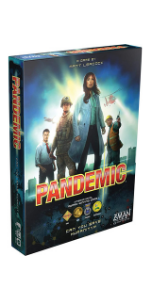
🧠 Strategize. Collaborate. Conquer. Save humanity before time runs out!
Pandemic is an updated cooperative board game for 2 to 4 players where you work as a team of specialists racing against time to cure four deadly diseases threatening the world. With an average playtime of 45 minutes, it offers dynamic role-based gameplay, adjustable difficulty, and high-quality components, making it a perfect blend of strategic challenge and social bonding for millennials seeking engaging, meaningful game nights.


| ASIN | B00A2HD40E |
| Best Sellers Rank | #6,264 in Toys & Games ( See Top 100 in Toys & Games ) #226 in Board Games (Toys & Games) |
| Brand Name | Z-Man Games |
| CPSIA Cautionary Statement | Choking Hazard - Small Parts, No Warning Applicable |
| Color | Multi-colored |
| Customer Package Type | Standard Packaging |
| Customer Reviews | 4.8 out of 5 stars 18,799 Reviews |
| Edition | Updated Edition |
| Estimated Playing Time | 45 Minutes |
| Genre | Strategy |
| Global Trade Identification Number | 00681706711003 |
| Included Components | Toy |
| Is Assembly Required | No |
| Item Dimensions L x W | 12"L x 8.6"W |
| Item Height | 1.7 inches |
| Item Type Name | Pandemic Board Game |
| Item Weight | 0.91 Kilograms |
| Language | English |
| Manufacturer | Asmodee |
| Manufacturer Maximum Age (MONTHS) | 180.0 |
| Manufacturer Minimum Age (MONTHS) | 156.0 |
| Manufacturer Warranty Description | No Warranty |
| Material Type | Paper |
| Number of Items | 1 |
| Number of Players | 2 to 4 players |
| Theme | Strategy |
| Unit Count | 1 Count |
S**D
Best game EVER!
Okay, to start out, I love love LOVE Pandemic! I admit it, I'm a bit competitive. I hate losing games. I'm generally fine with competitive games where the best strategist (or luckiest) wins, but I really dislike games (like Settlers of Catan) where some players can gang up on others. You pretty much don't have a chance when every other player is specifically playing against YOU. Pandemic is fantastic because you cooperative with the other players and you all win or lose together. I just absolutely love sitting at the table talking about all our options and strategizing together. My son introduced me to Pandemic several months ago, and I was hooked. We've spent several afternoons/evenings playing again--and again--and again. On many occasions when I am home alone, I play all by myself (playing two roles), and we've also played four players on several occasions. With two players and four epidemics, we win every time. With five epidemics, we win about 70% of the time. We've tried six epidemics a couple times, but have not been able to beat that game yet. Still trying! Ugh! As you increase the number of players, the game gets more difficult. With four players we've only played with four epidemics, and we win probably a little over half the time. I honestly think it would be impossible with four players and six epidemics, but someone has probably proven me wrong. We've even discovered another way to lose the game, which is not listed in the rule book! It says you can lose by having too many outbreaks, running out of disease cubes, or running out of player cards. We've lost in all those lovely ways. However, a couple of times, we've had only a few outbreaks, had plenty of cubes of each color left, and plenty of player cards. Three diseases cured, with only one to go. One of those times, we'd even gotten through all the epidemics, so there were none left in the infection deck! We've got it made, right? Uh, no. Turns out we discarded too many of the same color city cards, and there were only four left total, including in our hands and in the player deck. Neither of us was the Scientist, so that was an automatic loss. This is a danger when you get dealt a nice hand at the beginning, say two or even three of the same color. You decide to collect those, so when you discard, you are discarding the other colors. If you happen to keep drawing you "discard" color and it takes too long to collect the color(s) you want, you've now discarded too many of the other color and you don't have enough left at the end to cure the disease. Beware. We have also managed to lose the game on the very first turn. We were very unlucky drawing the infection cards when setting up the game: three on Karachi and Delhi, and two on Kolkata. Our first player did not have any way to get to that location to do even a little treating, and the first card drawn from the player deck was an epidemic. After resolving the epidemic, the first card drawn was Delhi, which caused a double outbreak (Delhi/Karachi) and put the third cube on Kolkata. The second card drawn was Kolkata, which was a triple outbreak (Kolkata/Delhi/Karachi) and lost us the game as there weren't enough disease cubes. Yep, lost on the very first player card drawn and there was not a single thing we could do about it. One slight change we sometimes make in the game is to draw 10 cards at the beginning instead of 9. The first nine infect the cities, and the tenth is where we place our player pawns and the first research station. It adds a level of difficulty to the game to not always start in Atlanta. We were noticing before that we always seemed to get in trouble with black and red, and we believe it was because all our players started so close to blue and yellow so those cities were easy to get to and treat. Now that we can start anywhere on the board, blue and yellow have become equal opportunity killers. There are a few things it is easy to get wrong. When the infection rate moves up, it's easy to forget to start drawing three cards (or four) since you're so accustomed to the lower number. It's also easy to forget to discard, not noticing that you have more than 7 cards in your hand. One scenario we've encountered a few times involves having 8 cards for literally a second. You meet another player on top of a research station, and share knowledge by pulling that city card from her. You now have 8 cards in your hand, but 5 of one color. Your very next action is going to be curing a disease, which will leave you with only 3 cards. But, before you cure that disease, you have 8 cards, so we think you have to discard one even though literally on your next action you will be discarding 5 cards. This is a little frustrating, but the rules specifically say that if you EVER (my emphasis) have more than 7 cards in your hand, you must discard (or play an event card). We were also a little confused by the role of the Researcher the first time we played. To be clear, when the Researcher shares knowledge, she and the other player must be on the same city, and the card can only go FROM the Researcher TO the other player (on either player's turn, as an action). She cannot take a card from the other player (and they cannot give one to her), unless it matches the city they are sitting on. It is also extremely easy to forget to infect cities after resolving an epidemic. You've spent a bunch of time resolving, then strategizing based on where the board stands now, and you completely forget that you still have to infect before going to the next player. Lastly, you are not supposed to choose your roles. We played with one person who had played before, and he said they always choose which roles they want. I suppose you can play that way if you want, but the game would be far less interesting because people would probably tend to choose the same roles every time. The instructions say to shuffle the role cards and deal them to each player -- that means they're supposed to be random. It's far more interesting and challenging when the roles change every time. A good part of the strategy is figuring out how to maximize the advantages that each role gives you in any given game. Pandemic is basically figuring out exactly how much effort you have to spend in each game sharing knowledge in order to cure diseases versus preventing outbreaks, all while maximizing the strategic use of whatever role you are playing. Spend too much time on one, and the other will get you. Sometimes you just have to say "oh well" and let an outbreak happen, even when you could have prevented it. It may just be more important to get to that one city in order to share knowledge than to get to the city where the outbreak is about to happen in order to prevent it. However we do try hard to prevent double outbreaks because things can get very bad very quickly when that happens. Okay I've rambled enough. If you're on the edge, buy this game! It's awesome. Every game is different and it never gets boring. It is equally fun with two or more players, although the more players, the more challenging it is. You can control the difficulty level by player with fewer or more epidemic cards. A+
S**.
The colors are fantastic and the set pieces are well machined
I got this game to give my wife and I something to play cooperatively rather than competitively. Everyone plays on the same side - you either all win or all lose. To that end, it's awesomely different. Quality: My wife was skeptical based on the product images she saw. When it arrived, however, we were blown away by the quality. The colors are fantastic and the set pieces are well machined. The disease cubes look so good they almost look like shiny candies on your game board. The board is solid. The cards are not flimsy. The game box provides sufficient protection and is thick enough to protect everything inside. Fantastic. Play: There is a lot of variety to this game. The inclusion of multiple roles, which you assign at random, creates a variety of play styles and strategy. The game also supports three difficulty modes (represented by the quantity of certain cards you mix into the deck). Once you get the hang of the rules, it's fairly easy on the lowest difficulty level (until you get the hang of all the ways you can lose, however, you'll find that you'll only win about 75% of the time). Ratcheting up the difficulty satisfyingly makes the game more challenging. It's not a given that you'll win, which makes it more appealing for replayability. Maxing out the number of players also makes the game more difficult, because you have less rounds by which to complete your objectives and win the game. Fun: I've played this game with family and friends, and everyone immediately wants to play another round. That's partly because it really takes playing a round to get the hang of the rules, but mostly because it is really different from the normal game. The cooperative aspect allows for a lot of group discussion, strategy, what-if scenarios, and so on. As soon as you've seen it in action - win or lose - you'll want to play again just to see what happens if different decisions are made or different roles are selected. Long-term, I'm still addicted to this game. My wife no longer is, and only feels like playing it every once in a while. It's still a welcome break from Settlers of Catan, which has been the game that I typically measure of my games against. Ease of play: There are a lot of rules to this game, which feels kind of overwhelming when you first play it. You absolutely do have to play at least a round to get the hang of the rules. Once you do, however, they don't feel all that bad at all. I've actually played this game successfully with younger children (since it is cooperative, you can do most of the thinking for them, yet still make them feel like they contributed and made decisions). At least one of my friends has purchase the game for himself and his kids after playing with me. Summary: Overall, this game is different. The cooperative element alone is worth the price of admission. Stay for the fun and the challenge. And the build quality makes it feel like it will last a long time in your possession.
S**T
The Greatest Cooperative Game Ever
Pandemic is a 2 to 4 player cooperative strategy game about doctors fighting diseases. All around, it’s a downright amazing game whether you’re a casual board gamer or a hard core one. Anyone who believes that the life of a doctor is boring or mundane might find a brand you appreciation for them when they play this game for the first time, but I think Pandemic’s biggest contribution to gaming is the standard it set for the many other cooperative games that came after it. In Pandemic every player is given a special role-card with a nameless character on it who has a special power that will be vital to winning the game. The game board itself is a map of the world with 48 of the most important cities connected to one another by white lines to indicate paths for movement. The four diseases you are struggling to cure are represented by tiny different colored cubes that will inhabit these cities, slowly making the population sicker and sicker. The players have two objectives that are vital to winning. If the entire supply of any one disease has been distributed across the board, the players loose. So part of the gameplay involves traveling to the world’s many cities to treat the inhabitants and removing disease cubes from those spaces. However, to overcome the diseases and win the game, players have a hand of different colored cards with the names of different cities on them. Players can travel greater distances by surrendering some of these cards, but the real goal is to visit one of the research centers on the board and surrender five cards of the same color to find a cure for one particular disease. Once the cures for all four diseases have been discovered, the players win the game. Much of the game’s intrigue comes from your hand of cards because in almost every game players will be unsure if they want to use those cards for transportation or save them instead for finding a cure. The majority of player to player interaction involves passing and exchanging these cards around to create optimal hands, but even that will prove a challenge. One of the hardest rules for the players to follow is probably the one that won’t let you exchange a card unless the city printed on that card matches the one you’re currently in. Having one person playing as the Researcher can be the greatest benefit to your team, since they get to ignore that rule. So on top of the player’s gameplay being very intriguing, the diseases also have an interesting gameplay style. The game’s difficulty is determined by how many Epidemic cards that you have shuffled into the Player Deck. The diseases themselves get a separate pile of cards called the Infection Deck. Each card from the Infection Deck has the name of a city where you will place one more disease cube at the end of each and every turn. Epidemic cards from the Player Deck are downright diabolical, because they will force you to take the discarded Infection cards and then put them back on top of the deck they came from. That means diseases will start targeting the same cities multiple times and players will be running back and forth trying to keep the diseases under control. Outbreaks are even worse, when there are already too many disease cubes on one city and the game will force you to put a cube on each connecting city instead. The mass mayhem and panic that starts to circulate around the game table is one of the most enjoyable things about Pandemic. The gameplay is a truly flawless experience, in my opinion. Turns tend to happen very quickly and each player’s unique power will strongly encourage coordination between everyone. Pandemic also balances dumb luck with careful strategic planning, because it’s possible you’ll already have the cure for a disease within the first turn of the game. However, if players don’t coordination their efforts and manage their resources wisely that is the path to certain doom. But it’s not only the balance and the coordination that makes the gameplay perfect but also the right theme. Playing as doctors and trying to do something as noble as fighting diseases is something that everybody in the world can truly admire. When the world is suffering from a pandemic it doesn’t matter what creed or nationality you are since everyone will pool their efforts to save humanity itself, hence the cooperative play. The art direction is also very complimentary of the theme. The game and the cards kind of remind me of a computer monitor that’s tracking the progress of each person and disease. It’s all very family friendly too, since there is no artwork portraying any gruesome pain or agony. Now, to nitpick on some of the game’s very few shortcomings, there are probably a few people who won’t be convinced a tiny colored cube represents a disease very well. Personally, this has never distracted me from an enjoyable game. Also, the spaces that represent each city can also be very small when trying to fit disease cubes, a research station and player pawns all together into a circle half an inch across. But once again, this has never been a problem to me if the game board isn’t shaken too much. So altogether, Pandemic is probably the single best cooperative board game that was ever created. It’s fresh and exciting every time I play it, and I always enjoy upping the difficulty to see how much better I can do against the diseases. Winning and loosing are both very fun if you work well together as a team. But even to this day, Pandemic is an example to other game designers trying to make cooperative board games, and it’s not very hard to see why when you pick it up and play it.
P**S
Fantastically fun cooperative board game.
This game is an absolute blast. And it is reasonably easy to learn (now this is not Sorry or Chutes and Ladders, but for someone that plays role-playing games like D&D, Munchkin, Pathfinder, etc., this is fairly easy), and yet definitely takes some time to master strategy which leads to good replay value. It is a great game for a 10 year old. She learned about geography and maybe a bit about disease, certainly good for problem-solving skills. We love that it is cooperative and we don't have to worry about hurt feelings (we can be a bit competitive with competitive games). The quality of the board, cards and pieces is high. There are a lot of small pieces (the disease cubes, about 7 x 7 x 7 mm) so be warned if you have a baby/toddler around (or a cat like ours that likes to jump on the board while we play), that this could be a definite choking/scattering/getting lost hazard. I would highly recommend this to anyone who thinks an intelligent, cooperative board game would be fun. And again, probably 10 years old plus and it is for 2-4 players. It does seem a bit harder with 2 than 4 players to be honest. Games take about 30-45 minutes and player number does not seem to affect that. You do lose or fail to save the world sometimes, but difficulty seems very appropriate after playing 5 or 6 times. You can adjust difficulty by putting in less epidemic cards (per rule book) or even tweakin rules a bit (allowing cards to be exchanged just by being in same city instead of same city and having card of the city) at first while you learn or with younger players. We tried this game with a 7 and 8 year old and, at least for those two, I do think this game was a bit too advanced.
J**E
Terrifically engaging board game
I am giving this game, the 2nd edition of Pandemic, 4-stars only because I feel the quality of the gameboard and components has decreased since the 1st edition. If it were only rating for gameplay, enjoyability, and replayability, I would give it the full 5-stars. This is a great game, with a lot of really clever game mechanics that can make it ridiculously hard to beat. All the players work together to defeat the game, and toward the end, it totally feels like an absolutely "uphill", all-or-nothing situation (I have lost a couple of times now just one player's turn short of curing the last disease). Since this is a cooperative game, it lends itself well to a small group of different players, and works well with a mixture of seasoned and newbie gamers. It can be prone to suffering from "micromanagement", if there is a very controlling person in the game, but since all moves are (and should be!) debated by the entire party, this person's dominance can be massaged out by consensus. It plays pretty well with 2 players, but it is best if BOTH players assume a couple different specialist roles. The rulebook is not very large, and for the most part, the rules are pretty easy to understand. The general rules are: Perform 4 actions - moving about the board, removing disease cubes, curing diseases, etc... Draw 2 Player Cards - used either for travel or collected to use to cure diseases, and ... Draw "X" Infection Cards - this number increase from a base of 2 up to a max of 4 cards; infection cards tell you which cities are experiencing an increase in infection. Most of everything else, rule-wise, can be determined by the print on the specialist cards or on action cards that are played to the discard pile. There are a few rules questions that pop up, since there is no specific clarification in the rules, like: "can my Researcher trade MORE THAN one card per turn?" (my answer: 'probably yes', since each trade counts as 1 action, and you get 4 actions per turn...), but these questions can usually be reasoned out. The experience of gameplay is different every time, because the players draw roles that feature special abilities (nothing like super-powers, but definitely helpful to the team), the setup mechanic of the game produces randomized locales of infection, epidemics, and near-outbreak, and the occurrence of Epidemic (in the Player deck) cards is randomized by shuffling, so significant infection events can happen at different stages each game. In a game last night, the first cards (setup) in the infection deck all seemed to be for the Red Disease (southeast Asia), and we were scrambling just to "put out fires" all night, with little opportunity to cure diseases; to make matters worse, all four of the Epidemic cards in play were in the top dozen or so cards of the Player deck (which was the result of sloppy preparation...). Needless to say, we all lost that one. Sorry, humanity... For new players, a walkthrough game really helps. My wife was not overjoyed with Pandemic in the beginning stages of our first playthrough. She felt that the rules were confusing at first, and she didn't feel engaged for a few turns, because I kept telling her what to do (... I would say, I was gently offering helpful advice); at first, I was offering A LOT of advice, then less and less as she picked up the rhythm and began to remember the rules (some of which can be a little fiddly, but start to make sense with some gameplay experience). After that first game together (a "win", remarkably) she looked at me and said " ... can we play another one, now?!?" So by the end of one play, she was a convert. We have the second edition, which has (to me, disappointing) plastic disease cubes, player pawns, and game markers. The 1st edition of the game had (again, to me, nicer) wooden components. [To quickly tell the difference, the 1st edition game has a picture of the "Researcher" wearing blue scrubs in prominence on the box cover; the 2nd edition has the "Scientist" front and center in a white labcoat] Other than the composition of the components, the game is unchanged from the 1st edition. I would have preferred the wooden cubes, pawns, and markers from the earlier edition, but the plastic versions are okay. I do have to say, I also prefer the look of the first edition game board over the newer one... I think the illustrated "pathogens" printed on the board makes it look too busy. Also, the colors printed on the board look a little too "jewel-tone" for my taste. Minor quibbles... If I had any "complaints" about the mechanics of the game, they would be: (1) that this - the base game, whatever edition you have - only includes a total of 7 specialist roles (expansions are available that offer more specialists). I feel that the base game would be more enjoyable and the replays would be more varied, if there were other specialists available from the start. ... and: (2) that the Intensify mechanic during an Epidemic phase can be too severe, especially with a very early epidemic. The Intensify mechanism is very clever, and is a great concept - hey, it almost GUARANTEES that viral hotspots are going to serve as outbreak locations! (cool, right?!?) - but it can tilt the balance of the game too far toward "utterly unwinnable" at a very early stage. I have suggested a "house-rule" where a party shuffles the discard Infection pile and only places a finite number of cards on top of the Infection deck (decided among the group at the start of the game), instead of the entire discard pile. It's not a perfect fix, but it helps ensure that, eventually, "some new cards" come out during infection, instead of the same 12-20 cards all evening... it's also cheating, though :|
K**H
A simply brilliant board game experience
Pandemic hardly needs more positive reviews, but I feel kind of obligated to add my two cents to the mix. This is a game that's really taken a preeminent position in the realm of modern cooperative board games, and with good reason. I think the biggest compliment that I can pay it is that it is pretty simple in terms of game-play but thoroughly addictive, the latter made all the more impressive by the fact that you lose the game about 75% of the time! It's no small feat to create a game that makes players want to keep coming back to it even AFTER they get their butts kicked again...and again....and again. Another thing I really like personally is that there's just enough luck and randomness to the game (in both the setup and during the game) that each game feels somewhat unique, which also helps the replay value. Put more simply: though you will start to develop a bit of a strategy after a few plays through, there's no "solving" the game in a way that reduces the challenge to the point of it becoming too easy or boring. If there's one thing Pandemics are not, it's predictable! If I have one criticism of the game it is that the aforementioned "luck/randomness" can be quite cruel; sometimes you seem to have everything under control (well, as much as you CAN when facing multiple, terrifying world-wide epidemics!) and then BOOM, a particularly unfortunate card-draw suddenly dooms your efforts. Actually, no that's not really accurate. It's more a case of simply not having the resources to deal with everything that needs dealt with at any given moment, which eventually leads to said un-dealt-with thing coming back and biting you in the a**. But it's never a case where you feel the game is inherently unfair, but more "AAAGGGHH I NEW WE SHOULD HAVE DONE ______ INSTEAD OF _______ WHEN WE HAD THE CHANCE!". Anyway, put simply, it's a very satisfying experience---win, lose or.....lose ;) (there's no draw in Pandemic; either you save the world or you don't!). One last note: you won't really see any mention of Pandemic being a single-player game, but it is very much playable solo. The only thing lost is the interaction between players (which granted, is the main appeal of cooperative games). Pandemic plays just fine solo though (you simply play two or more "characters" yourself)...so much so that I'm surprised the designer didn't just go ahead and say "1-5 players" instead of "2-5".
L**N
Extremely fun but challenging game!!!
It seemed like we’d just started the game and the yellow strain had not only been cured but eradicated! We were on the cusp of a cure for the second strain. This one was in the bag. We had weathered two epidemics so far without any egregious problems. Sure there was a pair of cities in Eastern Europe that was in danger, but what were the odds that was going to be a problem? One of us was already there. Then another epidemic hit, the infection rate increased, three cities were drawn and it seemed the cascading outbreaks knew no bounds. I think nearly everyone in Europe died that day, and we – a group of specialized scientists- were served a plate of bitter defeat. Again! Again and again, always defeat. Oh, the humanity! It’s true, I haven’t ever beat this rotten game and yet I keep coming back. Because one day I’ll win; in spite of all the wounds to my pride I’ve had to nurse, one day I’ll – I mean- we’ll win. I say we’ll because this is a co-operative game where you all work together against those nasty strains of no-doubt-human engineered beasties. Now, I know there are those of you who beat this every time you play, like I beat Shadows over Camelot every time I play, but I’ve invited those sorts to come play with me and they can barely stand the shame of losing with me. To make it even worse, we only play with 4 epidemics. I feel like I’m at an AA meeting: “Hi my name is Kyle.” “Hi Kyle” echoes the crowd. “I… I suck at Pandemic.” This is the part where you put your arm on my shoulder and tell me it’s going to be alright. Game Play This board is a handsome map of the world; only instead of country boards you see in Risk there is a red web of interconnected cities. Everyone starts in Atlanta were a research station is and you go from there. Each player plays a scientist that has a special ability: one can move others on their turn, one can give cards to another without the restrictions other players have and so on. The game also begins with 9 random cities around the world with varying degrees of infection (one to three stacked blocks). If a city would have a fourth block put on it (called an outbreak), it actually stays at three and the cities connected by the red web get a block. Isn’t that nice? It’s called a cascading outbreak. Such a pretty name. If you get 9 outbreaks in a game you lose. If you run out of blocks for a certain strain you lose, and if you haven’t cured all the strains before your white deck of cards runs out, you lose. I hate to be a negative Nancy, but there’s a lot of ways to lose this game. If, on the other hand, you are able to find cures for each strain, you win! How do you do that? Well you get someone who has got 5 cards of the same color in their hand to a research station, that’s how. One of the players only needs four. Every turn each player gets to do four actions. Picking up a cube off a city counts as one, so does moving between cities. You can charter flights with your cards, rather than use them for cures. You can build research stations and fly between those without expending a card, and a few other things. Then you draw cards that you think will help you, but can instead turn out to be epidemics. And you also draw cards for cities that get infected: usually this amounts to adding on square to the city’s pile. As the game progresses, more cards are drawn at a time to be infected. Oh, and when an epidemic happens, the cards for the cities that were infected get put back on the top of the draw pile. Oh dear. I hate to tell you what to do because what do I know anyway? Those of you who beat this all the time should tell me what to do. I understand that finding the cures is everything- lest you run out of time. Others say, make sure that you never have three on on e city at a time, as to avoid outbreaks. Make sure that the medic is only clearing off stacks of infections, the dispatcher should be moving people so that don’t have to move themselves. Again, I never win, so what do I know? Theme If it hasn’t been obvious, I am completely sucked in by the theme. There are similarities to other co-operative games especially Forbidden Island: Each character has special powers, you make moves for the team and then the board pushed you closer to defeat, that sort of thing. Forbidden Island also shares the shuffle the cards and put them back on top of the draw deck mechanic. I tell you this so that you won’t be surprised if you decide to add them both to your game closet, this is why I haven’t added Forbidden Island to mine, though I’ve played the game. While this adds to the evidence that the theme could be stripped out of the game, I don’t recall cascading flooding going on in Forbidden Island, or feeling like humanity is hanging in the balance, or being glad I don’t live anywhere in Eastern Europe. That is to say, I think the theme sticks. Balance I read about people who win all the time and needed the expansion to rouse any concern in them. But who can believe everything they read on the internet, I ask you? Just because I’ve never won though doesn’t mean that it’s not an enjoyable experience, mind you. Because I keep coming back. Interaction Interaction is very high. There’s all sort of collaborative discussion that goes on through this game. Learning Curve Low. It takes all of ten minutes to explain and there are directions on the board and the turn cards. Downtime Nill. You are all in it together! And you even get to move a guy in your turn. What’s not to Like? I actually know where some of these cities are on the map are but they all have these lines that go from the pin-pointed location to the circle where you actually place the blocks. That remains a bit annoying even after playing the game 10 times. Collateral Endorsement My four year old likes “The one where they get sick” We run around curing cities till the infection deck runs out. He feels a lot better about himself than the rage I feel playing by the real rules. Actually, as I think about it, the first time I played this game I was at the home of some friends and I think we won. But I’m certain I have not won with my copy of the game. I’d say mine is jinxed, but we’ve played on another friends copy and lost there too. Also, I should say that a brother of mine lost two in a row and saw the writing on the wall in the third game and left the table, swearing off the game forever. You might consider your own resiliency before buying this game.
G**L
Great, co-operaive fun
My kids played this after we got it for the family for Christmas, and they had a fun time, though I hadn't played. My middle daughter and her boyfriend played a second game with my wife and I for New Years, and so I tried it for the first time. Like any board game, it takes a little getting used to before play moves quickly. The 45-minute estimate was low even with only two brand new players, but it was less than ninety minutes even though we played a full game (i.e. we won). The co-operative mechanics are great for anyone looking to avoid a zero-sum game where every player's success comes at the expense of someone else. Those can be fun, but most games and groups quickly develop tiers, and who wins is decided often as soon as you pick what game you will play. Even when the winner isn't clear from the start, the loser(s) typically are. So co-op has real advantages unless you have a very balanced group. Also, the nature of game play lets you ease new players into the system. Each player's turn involves discussions with all players, so advice is entirely appropriate. Novices might feel left out, my wife's turns were often decided when she was away, but if you are careful, any player can be eased into the game and still be very useful. The limit of four players is affected as well. You can't have more than four players on the board, but that doesn't stop having one or more extra people offering advice and being a valuable part of the team as anyone with a token on the board. Despite the subject matter, the game isn't overly dark. This isn't Plague Inc, you're saving mankind, not wiping it out (Greenland and Madagascar, regrettably, are not represented). Little blocks, like Risk only clear plastic, are used to represent diseases. No need to worry about having too few blocks, either. If you run out, you've lost. So don't lose any pieces. Mankind may become extinct due to your carelessness! There is also a geography lesson involved, as many distant and exotic places will become important to you. However, compact areas of the world are handled by moving the name and having a line point to the real location to spread out the major metropolitan areas you try to save, While you can ramp up the difficulty level with pre-game choices, I doubt you'll be playing this every week for months at a time. The same is true of most games, of course, but I can see Pandemic becoming samey after a dozen games. In the meantime, however, it's a lot of fun, and an enjoyable group effort in the bargain.
Trustpilot
2 weeks ago
2 days ago